
Walk a Cobb County Street Directory
Walking a Cobb County street directory means separating ownership from occupancy at every step. The assessor links an address to a taxable parcel and its owner. Recorded title belongs to the Clerk. GIS reveals which lots front the road. Permits and dated city directory volumes add their own address evidence. No single source proves who lives at a door. Follow the records in a fixed order. Otherwise a spelling variant, a postal label, or a similar surname can drag the search onto the wrong piece of land in Cobb County.
- Enter only the house number and street in the Cobb address gateway. Save the parcel ID, situs, owner, mailing destination, exemption clue, and deed reference.
- Open Cobb GIS and move along both sides of the road by parcel shape. Record IDs before opening each tax record.
- Use the Clerk's Street Name mode, then narrow hits with legal description, book/page, CFN, parcel, or date.
- Search Citizen Access for permits and code cases. For an incorporated property, check the proper city custodian too.
- For an earlier household, select a Georgia Room volume for the correct city and year and inspect its reverse section.
One address becomes tested facts this way. The property roll and deed establish ownership. A listed resident may surface in a directory or a lawful voter file. Permit contacts show a tie to work, not automatic residence. Narrowing to one person? Use the Cobb County resident lookup.
Cobb County Street Address Gateway
The county's official property-search gateway is strict about input. Enter only the house number and road name. Leave off apartments, units, city, state, and ZIP. That matters in Cobb County. An East Cobb mailing may say Marietta, and a Vinings or Cumberland address may say Atlanta, even while county jurisdiction controls the permit record behind that address.
| Field | Type | Required | Cobb instruction |
|---|---|---|---|
| House Number | Text | Yes | Use the numeric street number |
| Street | Text | Yes | Leave out unit, city, state, and ZIP |
| Search Property Records | Button | No entry | Opens matching parcel information |
Save the search result before moving on. The parcel ID is the best handoff to GIS and tax sources. The property address and the owner mailing address answer different questions. A match, paired with a homestead indication, can support owner occupancy. It still does not describe a whole household. A mismatch might point to an estate, a trust, or stale mail. It might also point to some other arrangement in Cobb County. View Cobb County's address-search gateway.
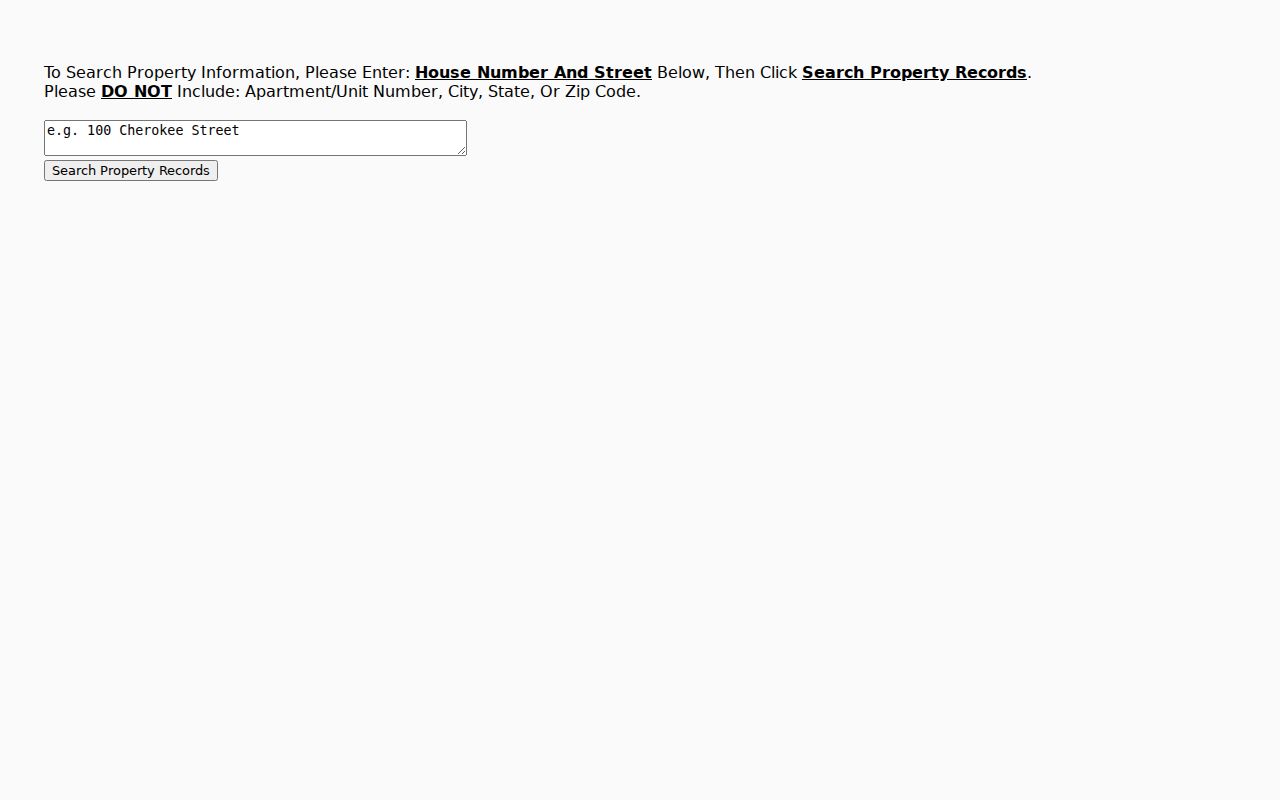
The narrow form explains why extra postal details can spoil an otherwise valid search.
Map Cobb County Streets by Parcel
The Cobb GIS program supplies the spatial half of a by-street search. Its layers separate active address points in the Cobb Address Repository from road centerline address ranges. Parcel or assessor data sits in its own layer too. Those layers update on their own schedules. An address may validate in one tool before its matching tax record shows up elsewhere.
Find the first parcel. Zoom in until lot boundaries read clearly, and write down its ID. Then click the edge-sharing lots and the ones across the road. Long lots, condominium parcels, common land, and rights-of-way all make rooftop position unreliable. If a pop-up omits the owner, carry the parcel ID to the assessor. The current viewer depends on the browser. Its exact select, measure, and export controls vary.
- Parcel
- A mapped unit of land used for tax and land-record identification.
- Situs address
- The physical location, which may differ from the owner's mailing destination.
- Plat
- A recorded survey showing subdivision, lot, block, streets, and easements.
- Criss-cross directory
- A directory arranged by street and house number instead of surname alone.
Cobb County Records Indexed by Street
Every Cobb street directory source records a different relationship. Start broad to find the land. Then move to the custodian who confirms the exact fact. The web offers core parcel, map, deed-index, and permit access, but the official office record controls whenever a display is unclear in Cobb County.
| Record | Keeper | Street evidence | Fallback |
|---|---|---|---|
| Property roll | Tax Assessors | Owner, situs, mailing destination, value, exemptions | 736 Whitlock Avenue; 770-528-3100 |
| GIS parcel | Cobb GIS | Geometry, road, address point, imagery | GIS at 770-528-8700 |
| Deed, plat, lien | Superior Court Clerk | Parties, book/page, CFN, legal description | Deed Room or mailed copy |
| Permit or code case | Community Development or city | Dated work, events, public contacts | Phone or targeted records request |
| Historical directory | Georgia Room | Listed occupant at publication date | Books, scans, staff appointment |
| Voter record | Elections and Secretary of State | Registered address, with protected fields withheld | Lawful voter-list request |
A parcel number joins tax records to mapped records. Book/page, CFN, and legal description connect land instruments to one another. A road name helps, but surveyed land is the steadier anchor. Note: A registered address, a recorded title, and a directory entry are separate facts. They are not an unsupported household claim.
Cobb County Street Deeds and Plats
The Real Property Web Public Inquiry offers several modes. These include Name, Book/Page, Instrument Type, Land Description, Cross Reference, Street Name, and CFN. A street-name result can be a deed, an easement, a lien, or a security deed. Read the instrument type before calling it a sale. CFN stands for clerk file number. It is built from a four-digit year and a seven-digit sequence. See the Cobb real-property search modes.
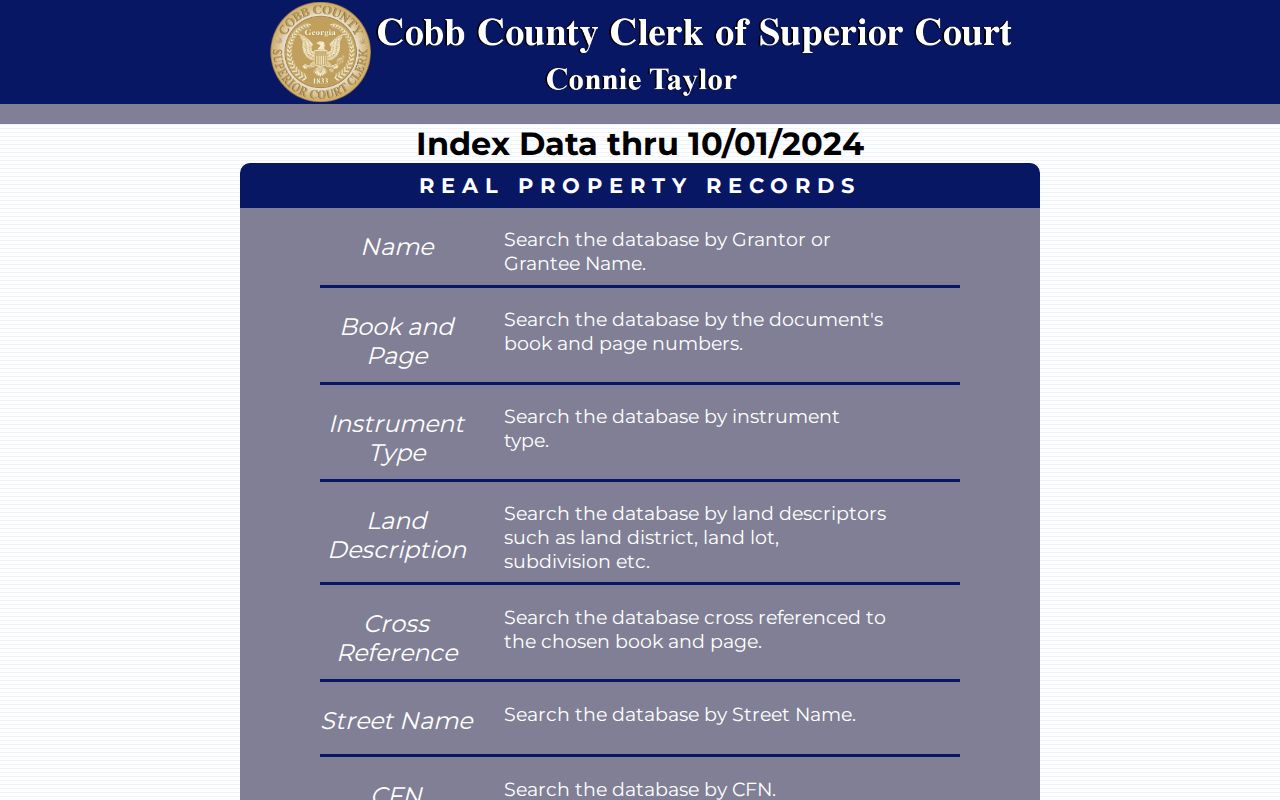
These modes let a Cobb County search move past loose road text. The anchors get firmer. Book and page numbers, CFN values, parcels, and land ties all help. Follow any prior deed reference inside the image. If the online chain breaks, take the last proven book/page and the full legal description to the Deed Room at 10 East Park Square, Building C, first floor. Its mail-copy route also works. Staff do not perform telephone research, though 770-528-1328 can confirm access details. Cobb publishes no earliest online index year for these deeds.
Cobb Land Lots Outlast Streets
Cobb County was created in 1832 from Cherokee lands. Land-lottery survey terms still appear in modern legal descriptions. The Clerk's Land Description search accepts Land District and Land Lot fields. Subdivision, Block, Lot, and Unit are options too. A subdivision or land district is the minimum required. Dates, book type, instrument, party role, and referenced name can narrow the results further. Inspect Cobb's land-description fields.
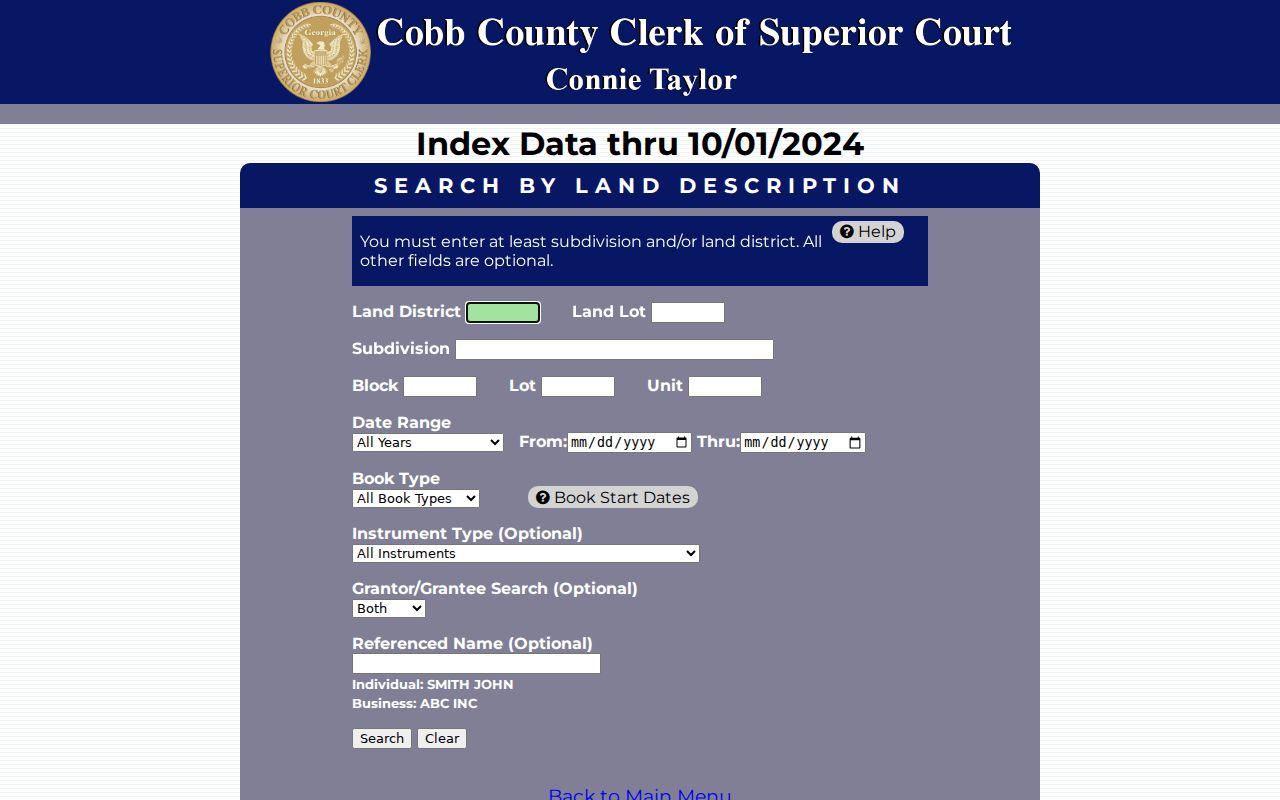
Survey fields keep the same land in view. Street labels and postal city names may change, but the acreage underneath does not. Cobb County publishes no authoritative countywide street-renumbering year. Resolve a suspected change through parcel ID, subdivision plats, land lot and district, old street directory volumes, and deed recitals. Deed recitals are often the clincher. The same approach sorts out rural-route entries and pre-suburban place names.
Cobb Address Permits and Cases
The Cobb Citizen Access portal covers building permits, inspections, applications, and code cases. Copy the number, type, and status. Add the applied, issued, and final dates. Save any public contact too. A contractor, applicant, or complainant linked to the matter is still not automatically the owner or the occupant. So read each name as a party to the case rather than a resident.
Jurisdiction matters. Cobb Community Development does not hold every record inside Acworth, Austell, Kennesaw, Marietta, Mableton, Powder Springs, or Smyrna. Confirm the boundary. Then check the city office when needed. If the portal fails, call Code Enforcement at 770-528-2180 or make a focused Georgia Open Records Act request. The agency must respond within three business days with access, timing, cost, or an exemption. It need not create a street compilation, though.
Permit records work best as a dated layer over the parcel. Compare an application date to the sale. Add the tax-digest owner. Close timing proves little. A permit before a sale may belong to the seller or a developer. One soon after may explain an addition, a new address point, or an inspection trail. Keep the exact status. An application, an issued permit, and a final inspection are not the same event.
Subdivision plats offer a second route. Use them when address text fails. Preserve the plat book and page, subdivision phase, unit, block, lot, land lot, and district. A plat may show that two differently worded addresses share one surveyed lot. It can expose former road labels, easements, or common areas too. It will not identify later residents, so carry its survey facts back into the deed index.
Cobb Voters Along a Street
Georgia's My Voter Page is an individual lookup. It returns registration status, polling place, districts, sample ballot, and absentee status for one voter. It is not a browseable roll of everyone on a road. Public voter lists may include names and addresses under O.C.G.A. §§21-2-225 and 21-2-226, subject to statutory use, order format, and fee terms.
For a lawful file request, go through Cobb Elections or the Secretary of State voter-list channel. Some fields stay closed. Month and day of birth, ID numbers, ballot choices, nonvoters, and VoteSafe addresses are excluded. A registration address only supports registration there, not current presence or a whole household.
Treat voter evidence as one dated point in a wider Cobb street directory. Keep the file date. Keep the exact address. A missing name has many possible causes, from nonregistration and an old address to a protected address or a spelling mismatch, so absence cannot identify who occupies the parcel.
Cobb County Streets in Old Directories
The Georgia Room at Switzer Library keeps a strong run of local volumes that can place a listed occupant at an address on a publication date. Marietta titles cover 1883, 1884, 1936, 1938-39, 1941, 1944, 1947, 1950, 1952, and 1956. Marietta/Smyrna runs span 1958-60, 1962, and 1964-70, while four-city titles exist for 1977, 1985-86, and 1987. Austell/Mableton volumes cover 1967 and 1969-74.
A reverse section, when a volume includes one, works like a paper street directory. You find the road, scan house numbers, and copy nearby entries. The inventory does not say which volumes carry a reverse section, so check the contents and key yourself. The Cobb County city directory covers these collections in depth. Georgia Room staff also offer noncirculating maps, microform, vertical files, and free one-hour genealogy appointments at 770-528-2333.
These volumes add occupant, spouse, and occupation detail, yet each is only a dated snapshot. Pair them with the parcel and deed valid at the time. Current portals reveal owners and transactions; old directories supply the occupant evidence.
Limits of Cobb Street Records
A Cobb street directory can never become a complete resident roll. Assessor and deed systems name owners or title parties, not every occupant. Directories omit people and age quickly. Voter rolls exclude nonvoters and protected fields. No single source lists everyone. DMV addresses, utility customers, school records, delivery accounts, and library accounts are not public street lists either, and the gateway may suppress unit detail.
Some safeguards are built in. Qualified owners can seek removal from the assessor website. VoteSafe shields the address of an eligible voter who holds a protective or restraining order or lives in a family-violence shelter. These are not errors to work around, so verify a limited public fact with its keeper whenever a screen conflicts with an office record.
Online indexes change. Preserve the search date, record number, and source URL. A missing web result may call for the assessor counter, the Deed Room, Community Development, the Elections office, the Georgia Room, or a narrow open-records request. Ask for an existing record, not a custom list. This chain matters most when a portal is down or the official file spells the road differently from today's sign.
Lawful use. Cobb address records support genealogy, deed research, consumer safety, and civic review. Never use them to stalk, harass, intimidate, or harm a person.