
Finding Cobb County Residents
Cobb County keeps no master list of who lives where. Every public record answers a smaller question instead. The tax roll links a parcel to its owner. Recorded deeds name buyers, sellers, and legal descriptions. Court dockets tie named parties to filed cases. Historical directories can even name occupants who never held title to anything. That split shapes every Cobb County residents directory search, so define the claim before you start. Are you after a current owner, a registered voter, a party to a case, a former occupant, an heir, or a business contact?
Dates matter as much as names. A portal result may be current, refreshed nightly, or frozen at the date an instrument was recorded. Common surnames also demand a second match, whether a middle initial, parcel number, spouse, case number, or known street. And remember that owners are not always occupants. An owner's mailing address can differ from the situs address, which is the physical location of the parcel itself.
- Enter a street address in the county property gateway to identify the parcel and owner.
- Keep the parcel ID, legal description, and deed book and page as stable reference points.
- For a named person, check the separate State, Superior, and Probate Court searches when relevant.
- Use the Georgia Room's directories and microform when the question concerns a past household.
- Ask the correct custodian for an existing record that is not available online.
Cobb County Directory Custodians
Three offices anchor the Cobb County residents directory trail. The Superior Court Clerk records deeds and other real-estate instruments. The Board of Tax Assessors maintains parcel ownership and valuation data. Cobb Elections handles local registration. Meanwhile, Georgia's My Voter Page lets an individual securely confirm personal registration and district details. Each office documents different facts. Compare their records rather than treating them as interchangeable. The Cobb County street directory walks through the address-to-parcel path in full.
Superior Court Real Estate Division
10 East Park Square, Building C
Marietta, GA 30090
770-528-1328
Cobb Board of Tax Assessors
736 Whitlock Avenue, Suite 200
Marietta, GA 30064
770-528-3100
The assessor page is the official entry to the county property roll. The screen appears in the Cobb Tax Assessor source below.
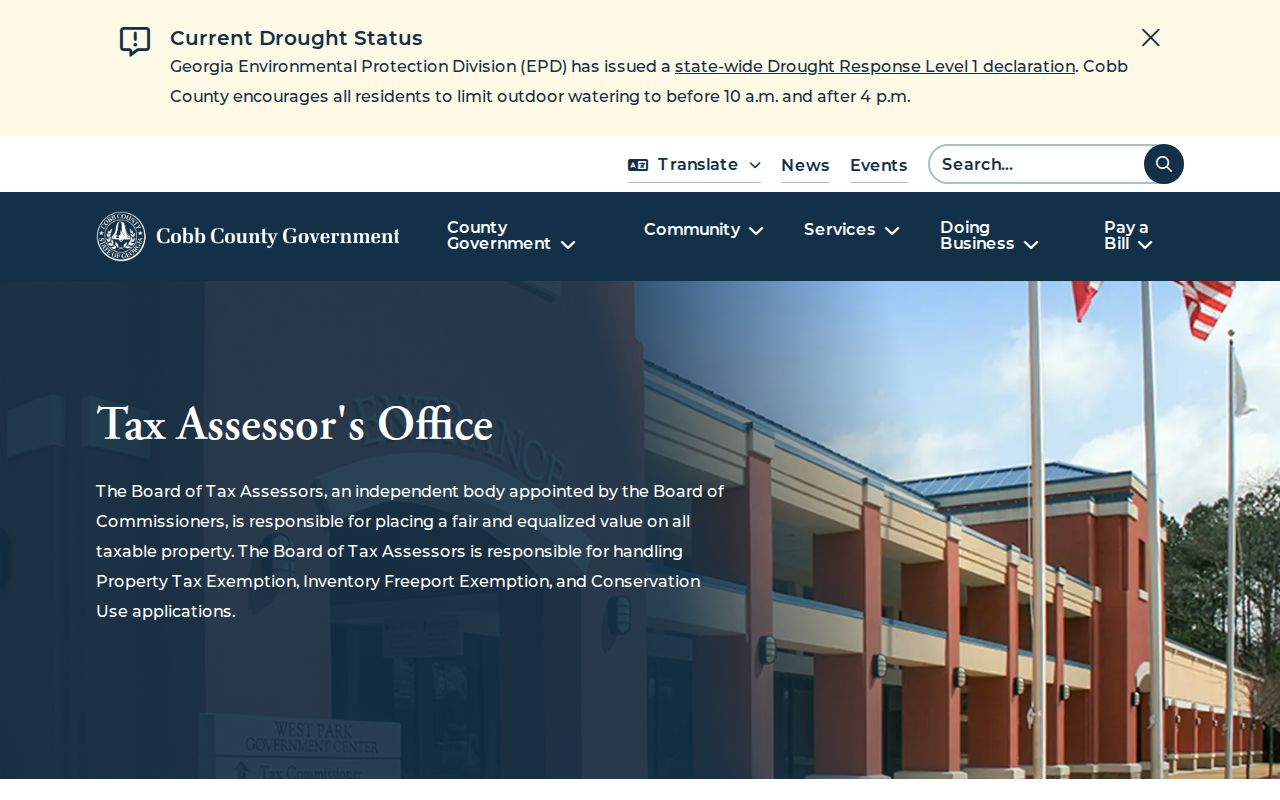
The county page opens onto searchable owner, address, parcel, and assessment tools. When data looks wrong, the assessor's office is the place to question or correct it.
Cobb County Address Record Clues
The county's narrow address gateway asks for just a house number and street. It wants no apartment or unit, city, state, or ZIP. That small quirk prevents many false no-result searches. Once a record opens, write down the parcel ID, property address, owner, tax district, property class, and deed reference. A parcel is a mapped unit of land with its own identifier. When a property changes hands, that ID stays steadier than any person's name.
- Situs address
- The physical address assigned to the parcel.
- Mailing address
- The destination where the assessor sends owner correspondence.
- Parcel ID
- The county's stable identifier for a mapped tax parcel.
- Legal description
- The land district, land lot, subdivision, block, or lot language identifying the land.
An owner mailing address can support occupancy if it matches the situs. Still, it cannot prove it. A homestead exemption is a stronger owner-occupancy clue. Even so, it never names every person in a household. Trusts, estates, and business entities can all change what appears online. So can redactions for protected people and delayed updates. Expect gaps and treat each field as a clue.
Note: Keep the parcel ID before leaving the assessor record, because it reconnects an address to maps, taxes, and recorded deeds.
Cobb County Deed Directory Modes
The Clerk's real-property inquiry offers far more than a basic name box. Search modes include name, book and page, instrument type, land description, cross-reference, street name, and CFN. Some modes cover parcel and legal-description queries too. CFN stands for Clerk's File Number. Cobb defines it as a four-digit year plus a seven-digit sequence. Leading zeroes in the sequence may be dropped. The current Landmark interface also exposes parcel ID, record-date range, instrument number, and legal-description searches.
| Index route | Best use | Key caution |
|---|---|---|
| Name | Find grantors or grantees | Try spelling variants |
| Book and page | Open a cited instrument | The official office record controls |
| Street name | Review filings tied to a road | Street text can change |
| Land description | Hold to a land lot or subdivision | Subdivision or land district is required |
| CFN | Retrieve a known filing | Retain the full year and sequence |
A deed image can add recording time, transfer details, return-to information, party names, land lot and district, subdivision lot, and a referenced plat. Handle those details with care. The index is only a finding aid. A certified copy must come from the Clerk. The Deed Room also resolves uncertain coverage and copy needs at the courthouse counter or by mail.
Current Cobb County Resident Records
Modern sources resemble a directory only within their own limits. The assessor lists owners, not whole households. The deed index lists parties to recorded instruments. Court indexes list case parties. Voter access splits between a personal lookup and public lists obtained under Georgia law. Official business and license systems can verify a named role or credential. A registered-agent or office address, though, should never be relabeled as a home.
| Official source | Fact it can support | Custodian | Access route |
|---|---|---|---|
| Property roll | Owner, parcel, situs, mailing address | Tax Assessors | Free web tools and office |
| Real-estate index | Parties, filing, land description | Superior Court Clerk | Web index, Deed Room, mail |
| Court dockets | Named party, role, case events | Separate court clerks | Portal and official file |
| Voter records | Registration and district information | Elections and Secretary of State | Personal lookup or list request |
| Georgia Room | Past named occupants and family clues | Cobb County Public Library | In-person shelf, databases, staff help |
Start with the name itself. Write down variants, suffixes, an approximate age, and a known Cobb place before searching, then log the source URL and access date. The Cobb County resident lookup depends on that verification sequence, not on turning a loose name match into a claim.
Separate Cobb County Court Directories
Cobb County keeps no single court search. Each court runs its own system. State Court publishes civil records separately from traffic and misdemeanor cases, while Superior Court splits its index into civil and criminal tabs. Probate Court takes a different approach. There, a researcher picks a document type and searches by case number, application name, or an event-date range. Magistrate Court maintains yet another index. A citation written in Marietta or another incorporated city may stay in that municipal court instead.
The Cobb State Court search is a good model of a party search. It offers civil and criminal modes, first and last name fields, phonetic matching, and case-number lookup. Criminal searches add a birth year. Filing-date ranges narrow results further.
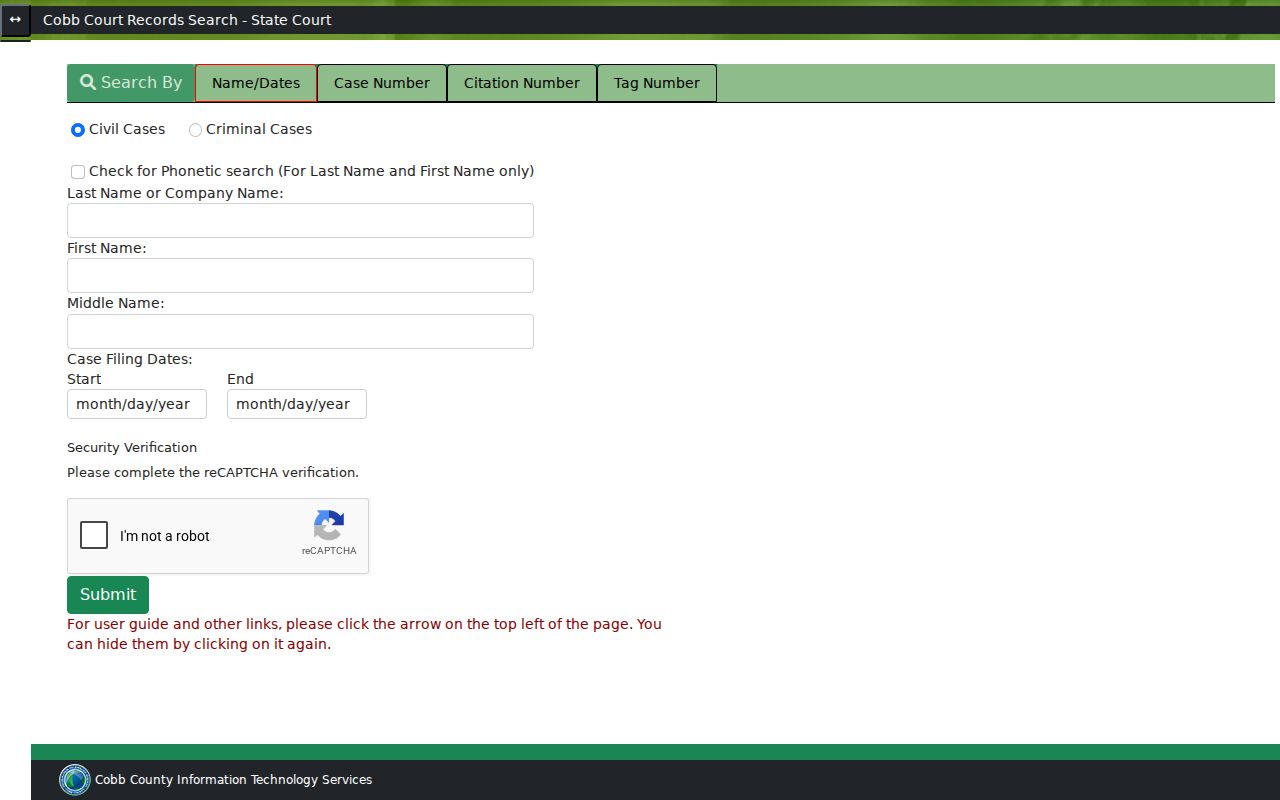
State Court refreshes its web data every night. Civil coverage reaches back to March 17, 1997, and traffic and misdemeanor coverage to April 26, 1999. If a screen and the clerk's record ever differ, the official file at 12 East Park Square controls.
Cobb County Probate Family Records
Family records in Cobb County sit with several different keepers. Marriage-license copies and estate files come from Cobb Probate Court. Birth and death certificates from 1919 forward belong to Cobb and Douglas Public Health. Divorce files rest with the Superior Court Clerk. Georgia limits birth certificates to eligible applicants. Death, marriage, and divorce records stay open to the public. Protected identifiers are redacted before release.
The Cobb Probate Document Inquiry shows the workflow. A visitor selects a document type, then searches by case number or application name.
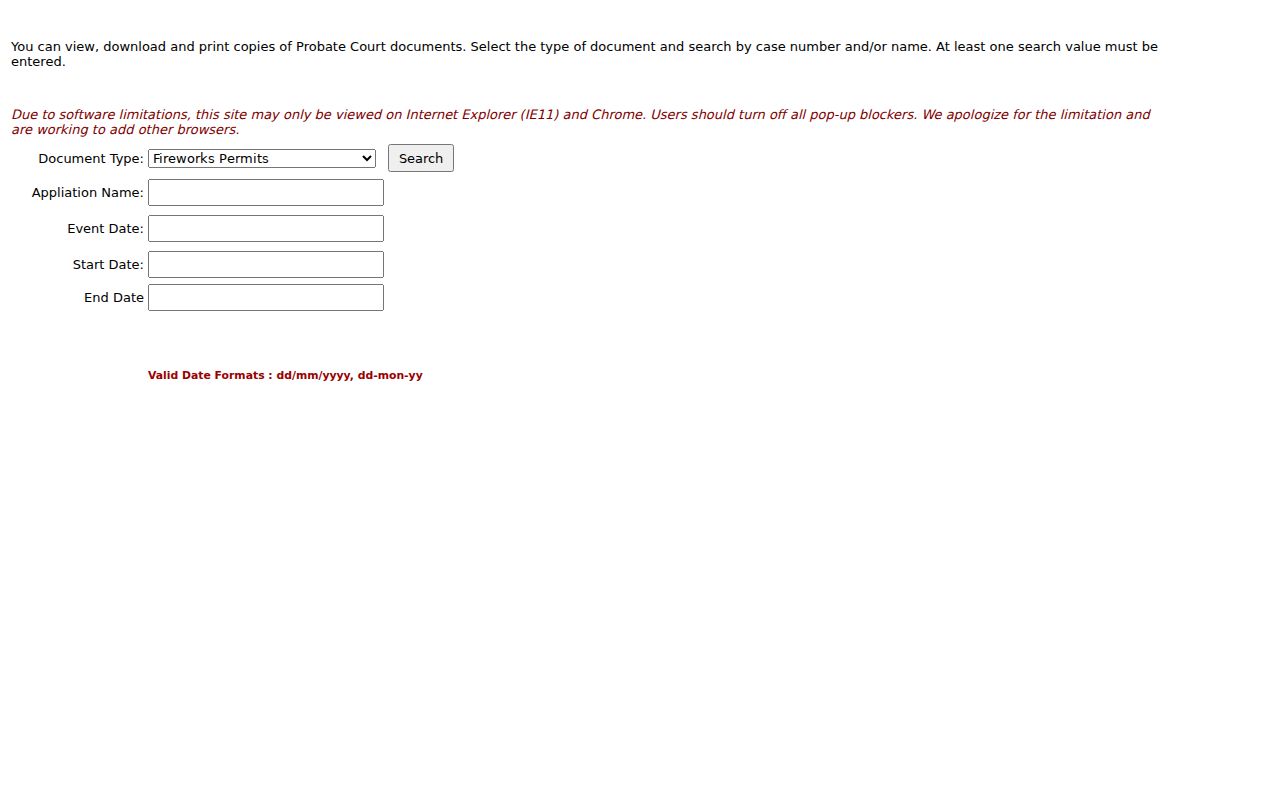
Probate paperwork can tie a deceased resident to relatives and real property. Petitions, orders, wills, and the names of executors and heirs all connect people to places. Some guardianship and sensitive files remain limited. A portal image helps with research. But only a certified copy serves as the formal record.
Georgia Voter Directory Boundaries
Georgia's My Voter Page works on an individual basis. You enter your own identifying details. In return, the page shows registration status, polling place, districts, sample ballots, and absentee information. It is not a free-form directory for looking up any neighbor. Public voter lists fall instead under O.C.G.A. §§ 21-2-225 and 21-2-226, which permit names and addresses but withhold month and day of birth, identification numbers, and VoteSafe-protected residence addresses.
The Georgia My Voter Page is the official personal access point.
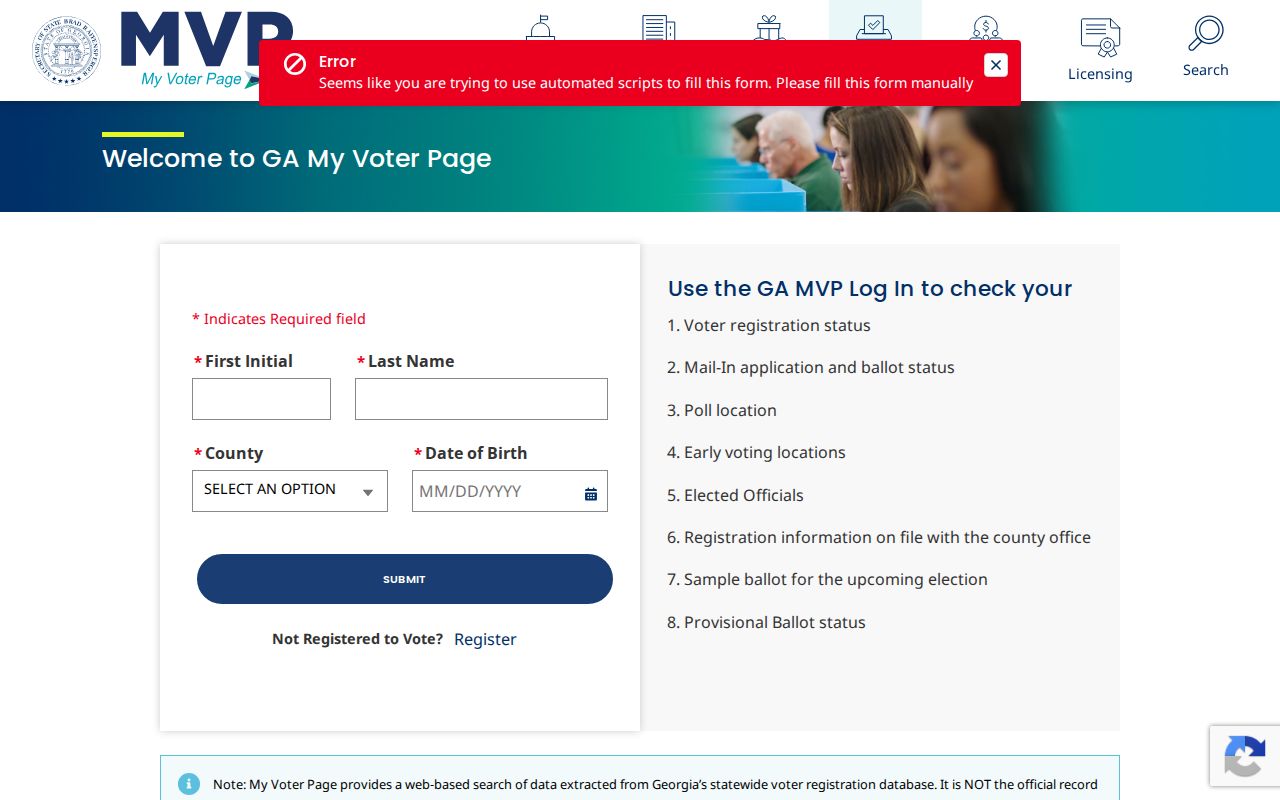
VoteSafe shields the residence address of registered voters under protective or restraining orders, or those living in a family-violence shelter. That protection is a firm boundary, not a gap to work around. Voter rolls never reveal how anyone cast a ballot.
Cobb County Records Beyond Portals
Portals are only one channel into Cobb County records. The Real Estate Division keeps a Deed Room and accepts mailed copy requests. Court clerks provide ordinary or certified copies. The official case file always controls over the online docket. Public Health takes vital-record requests in person and by mail, and state methods also apply. The Georgia Room holds noncirculating volumes, microform, and databases, plus one-hour genealogy help appointments. The Georgia Archives keeps county microfilm and older government records.
A county record sometimes exists but is not published. The Georgia Open Records Act offers a path. A focused request should name the custodian. It should also list the record series, the date range, and the preferred electronic format. Under O.C.G.A. § 50-18-71, the agency must produce available records within three business days. Otherwise it must state the expected timing, cost, and legal basis for withholding. An agency does not have to build a new list that never existed.
The state's open-records request form shows the description and delivery fields a clear request uses.
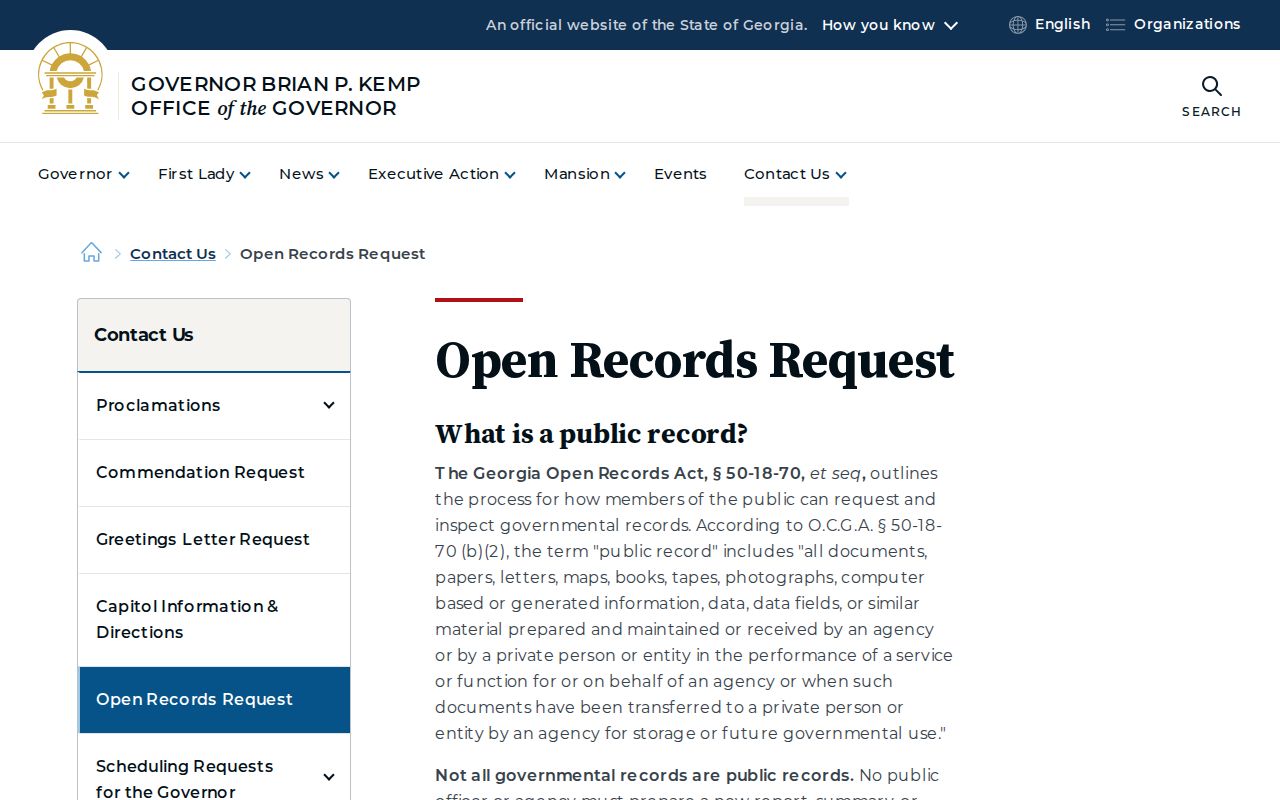
The form makes the point plainly. Requests work best when they ask for records that already exist, not for research or a newly compiled directory. Anything Cobb-specific should still go to the county office holding the material.
Cobb County Record Indexes Versus Proof
A search result is a lead, not proof of current residence. Cobb's State Court cautions that its online data is unofficial. The deed search points to a recorded instrument. Yet it names no occupants beyond the parties. The assessor reflects an annual tax process. It also separates the owner address from the property address. Printed directories only capture what a publisher recorded in one edition. Any source grows stronger when a second independent record agrees with it.
| Finding aid | What to verify | Best follow-up |
|---|---|---|
| Portal name hit | Identity, role, date | Official file or certified copy |
| Owner record | Whether owner also occupied | Homestead clue, directory, dated record |
| Directory entry | Spelling and edition year | Adjacent editions, census, deed, probate |
| Commercial compilation | Source date and errors | Return to the named official custodian |
Commercial people-finding sites have known flaws. They can merge strangers with similar names, keep stale addresses, and hide their source dates. Treat every match as unconfirmed until a public custodian's record backs it up, and never republish sensitive detail just because a document is open.
Cobb County Filing Alerts
The Georgia Clerks' Authority runs a free Filing Activity Notification System, known as FANS. A user registers names of interest. A real-estate, lien, or plat filing may be indexed under one of those names. The system then sends notice. That can help an owner spot activity early. But it cannot prevent a filing. It cannot judge whether a deed is valid. It also cannot replace review by the Cobb Clerk's Real Estate Division.
Georgia also rewrote its electronic real-estate filing rules in January 2025. The new rules add identity-verification requirements for electronic filers. For anyone using a Cobb County residents directory, the practical habit stays the same: preserve the index identifiers, inspect the recorded image, and ask the Clerk when authenticity or status matters.
Historical Cobb County Directories
Switzer Library's Georgia Room is the local shelf for past Cobb residents. It holds Marietta and Acworth directories from 1883 and 1884; Marietta volumes for 1936, 1938-39, 1941, 1944, 1947, 1950, 1952, and 1956; combined Marietta and Smyrna volumes for 1958-60, 1962, and 1964-70; broader Marietta, Smyrna, Acworth, and Kennesaw editions for 1977, 1985-86, and 1987; and Austell and Mableton volumes for 1967 and 1969-74.
A city directory may list a resident's name, spouse, occupation, employer, or street address. Some editions include an address-arranged section that works in reverse, turning a street into names. Read the exact entry and its abbreviations, then compare the editions before and after it. Census schedules, deeds, newspapers, probate files, and vital records can bridge missing years and distinguish an owner from an occupant.
The Georgia Room overview shows the collection's local-history setting.
Materials do not circulate, but no appointment is required. Staff at 266 Roswell Street in Marietta can also help with microform, obituary-oriented vertical files, and genealogy databases. Full collection details belong in the Cobb County city directory.
Note: Cobb County was created in 1832, and its early land-district and land-lot terms still anchor many modern legal descriptions.