
Cobb County Previous Resident Sources
The age of the question decides which Cobb source should lead. Current parcel and deed systems establish the land and title. Printed directories add occupants at publication dates. Census schedules reveal an enumerated household every ten years, and permits or probate can explain changes between those snapshots. The exact street number may be the least stable part of an older search.
| Source | Years it covers | Where held | What it shows |
|---|---|---|---|
| Deed index and images | Current portal; earliest online year not stated | Landmark and Cobb Deed Room | Legal owners and descriptions |
| Marietta directories | 1883, 1884; selected 1936-1956 | Georgia Room | Occupant and address snapshots |
| Marietta/Smyrna directories | 1958-1960, 1962, 1964-1970 | Georgia Room | Households during suburban growth |
| Four-city directories | 1977, 1985-1987 | Georgia Room | Marietta, Smyrna, Acworth, Kennesaw entries |
| Austell/Mableton directories | 1967, 1969-1974 | Georgia Room | South Cobb occupant evidence |
| Federal census | Public through 1950 as of 2026 | NARA and library databases | Enumerated household, age, relationship |
| Permit history | Portal has at least a 2009 example; first year unstated | Citizen Access or city office | Construction events and public contacts |
Start with the newest reliable evidence and move backward. A directory year near a census year is especially helpful, but neither proves ownership. Note: Cobb's archive date marked “Index Data thru 10/01/2024” was an update-through date, not the earliest available deed year.
Start With the Cobb County Parcel
Enter only house number and street at the Cobb property gateway. Leave out unit, city, state, and ZIP. Record the parcel ID, property or situs address, current owner, mailing destination, homestead clue, legal description, subdivision and lot, and the newest deed reference if shown.
The situs is the physical parcel address. The mailing destination is where the owner receives notices. A match can support owner occupancy but does not list all previous residents. A mismatch can have many causes. Parcel ID and legal description are safer bridges because postal cities, municipal limits, route labels, and street spellings may shift.
No official countywide renumbering year was located. When old and current addresses conflict, test subdivision, lot, block, land lot, district, plat, and adjoining properties before declaring two addresses the same.
Trace Cobb County Owners Backward
The Cobb real-property inquiry supports person, book/page, instrument, land-description, cross-reference, street-name, and CFN searches. Use those modes to build the title chain, a linked sequence of conveyances affecting the same land.
- Find today's acquisition deed by parcel, Street Name, Legal, or Book/Page. Open the image and record buyer, seller, execution and recording dates, full legal description, CFN, and any prior-deed citation.
- Search the seller as a grantee, which means buyer, within an earlier date range. Confirm the same land description, not merely the name.
- Prefer a direct prior book/page citation when the deed supplies one. Repeat seller-as-grantee for each earlier transfer.
- Separate security deeds, which show financing, from deeds that convey ownership. Save plats and cross-references that identify the same lot.
- If the web fails, take the last proven book/page and legal description to the Deed Room at 10 East Park Square or use its mail-copy route.
- Grantor
- The party conveying an interest, commonly the seller.
- Grantee
- The party receiving an interest, commonly the buyer.
- Chain of title
- The linked sequence of recorded ownership transfers for the same land.
- Legal description
- Survey-based text that identifies land more reliably than a street label.
The Deed Room does not conduct telephone research, but 770-528-1328 can confirm access. The current office record controls when a web image or index entry is incomplete.
Keep Cobb Land Constant
Land district and land lot come from Georgia's old survey system and still appear in Cobb instruments. The Clerk's Land Description form also accepts subdivision, block, lot, and unit. At least subdivision or land district is required. Those fields can recover a deed missed by a changed road name or a new postal label.
A deed image can add far more than an index row: recording stamp, CFN, book/page, grantor, grantee, consideration text, return-to address, land lot and district, subdivision lot, and incorporated plat. Preserve the whole recording stamp and description. A prior deed or plat reference several pages into the instrument may be the cleanest route around a misspelled name.
Cobb's Clerk search interface illustrates the address-to-title handoff. Use the current Landmark property-record search for live work and the archive inquiry for its documented modes.
Cobb County Previous Residents by Era
Deeds identify title parties, not every person who lived at an address. Add the household layer from the Georgia Room's city directories and the public federal census. Pair the 1883-1884 directories with the 1880 census, the 1936 and 1938-1939 volumes with 1940, and the 1947, 1950, and 1952 volumes with the public 1950 schedule.
- Select the directory title that covered the address's city at that date.
- Check for a reverse section and search the street number. If none exists, use the known owner or occupant in the alphabetical section.
- Copy the entry exactly, including initials, spouse notation, occupation, employer, and nearby house numbers.
- Find the matching census household by name, place, and enumeration district. Compare ages, relationships, and address context.
- Use the next directory year to test whether the same household stayed, changed, or vanished.
Printed geography changes with the county. Marietta-only titles expanded to Marietta/Smyrna and later to Marietta/Smyrna/Acworth/Kennesaw, while Austell/Mableton had a separate run. Absence from one book may reflect its footprint, not absence from Cobb. The Cobb city directory collections explains those holdings in full.
Cobb County House Record Fallbacks
The Georgia Room does not advertise a separate “research your house” service, but its collection is the strongest local fallback. At Switzer Library, 266 Roswell Street, researchers can use noncirculating directories, microform, maps and atlases, Cobb vertical files, and local newspapers. Free one-hour appointments with a genealogy librarian are available through 770-528-2333.
The Georgia Archives adds county microfilm, land-lottery indexes, tax-digest material, maps, church and cemetery files, and other genealogy resources. Its County Records Microfilm Index is vital for older Cobb books. The Archives warns that a courthouse disaster date does not mean every record disappeared.
Open the Georgia Archives county-record microfilm index.
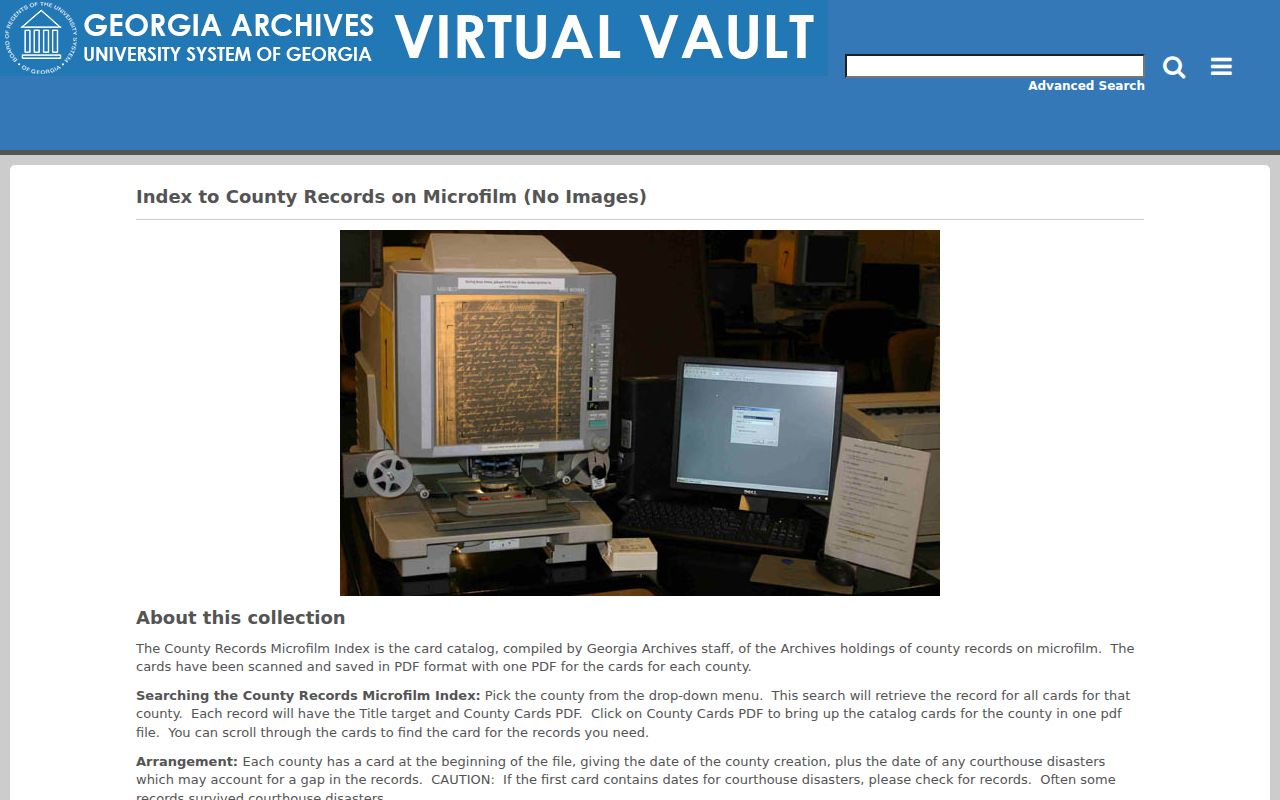
The county cards identify surviving series and reels, which is more reliable than assuming all early Cobb material was lost.
Cobb Records After 1864
Cobb County was formed in 1832, so earlier land evidence belongs in state land-lottery or predecessor sources. The courthouse was destroyed in 1864 during Sherman's campaign. A replacement was completed in 1873, and later courthouse changes moved older material into archive and microfilm settings.
The destruction is an important warning, not proof that every early series burned. Search the Georgia Archives county cards for the actual deed, probate, tax, and court books that survived or were filmed. State copies, tax digests, newspapers, church and cemetery files, federal schedules, and land-lottery material can bridge a true gap.
That story also explains why a modern road search may stop well before the land's history does. Switch from street text to land lot, district, plat, tax digest, and archival series when the deed chain reaches a damaged or unindexed period.
Cobb Permits and Probate Clues
Search Cobb Citizen Access by normalized site address. Record each permit or application number, type, status, and applied, issued, and final dates. A permit can date construction or an addition, but the applicant or contractor is not automatically a previous resident. For land inside a city, repeat the search with that city's permitting office.
If title passes after an owner's death, use the Cobb Probate Document Inquiry by name and date. Public petitions, letters, and orders may identify a fiduciary, heir, or successor who explains the next deed. Obituaries and the Marietta Daily Journal collection at the Georgia Room can add dates and family links, though no official standalone Cobb obituary index or exact newspaper coverage run was found.
Return from every probate or permit clue to the same legal description. Timing can guide a search, but it cannot prove who did work or lived at the property.
Limits on Cobb County Previous Residents
Previous-resident research is strongest when each statement names its source and date. “Owner on the deed,” “listed at the address,” and “enumerated in the household” are different claims. A directory may omit a person or use initials. Rural entries may use RD. Married women may appear under husband-linked forms, and scan errors require checking the page image.
Sanborn fire-insurance maps may date a building footprint, use, or construction detail, but no official Cobb-specific list of available years was located. Verify Marietta coverage in the Library of Congress catalog or with Georgia Room staff before citing a map year. Modern assessor and GIS screens may also redact protected ownership details.
When two records disagree, return to the image or official file and compare dates, land descriptions, middle names, spouses, and adjoining addresses. Record the conflict rather than forcing a match. A later corrected deed or a directory published from older canvass data may explain the difference.
Lawful use. Trace Cobb previous residents for family history, house history, estates, or personal curiosity. Never use living-person details to stalk, harass, track, or harm anyone.