
Cobb County Neighbors by Source
The immediate block is best read as a set of parcels, recorded owners, lawful voter-list rows, and community contacts. These sources do not form a complete household directory. Cobb County GIS locates each lot around the starting point. The assessor supplies the owner, physical site, mailing address, and parcel facts. Recorded deeds and plats add title and subdivision context. Georgia voter data can add registered names and address fields, but protected information and use limits still apply.
| Source | What It Shows About a Block | Access |
|---|---|---|
| Cobb GIS and parcel map | Lot shapes, adjacent parcels, addresses, and map layers | Free browser tools |
| Cobb Tax Assessor | Owner, situs, mailing address, parcel ID, and tax facts | Free property portal |
| Clerk real-property index | Deed parties, filing dates, book/page, street or land description | Free index; Deed Room fallback |
| Georgia public voter file | Lawfully released voter and residence fields by geography | Paid official list request |
| Neighborhood associations | Association names and public officers or contacts | Public contact page or direct request |
Owner and occupant are not synonyms. A matching situs and mailing address may suggest owner occupancy, but it does not name a spouse, child, renter, guest, or other household member. An out-of-area mailing address can suggest an absentee owner, yet even that needs context. Keep a column for what the source proves and another for what it merely suggests.
Map Cobb County Neighbor Parcels
Start with the county address gateway, then move from the known parcel to the lots that touch it. The Cobb GIS Property Search expects house number and street. Its instructions exclude apartment or unit, city, state, and ZIP. That narrow format matters because adding postal detail can prevent a valid Cobb address from matching.
- Enter only the house number and street in the Cobb address gateway, then open the matching parcel result.
- Record the parcel ID, situs address, owner, and mailing address. Situs means the physical location of the parcel.
- Open the map and click each adjoining lot. Work clockwise so no side or rear neighbor parcel is skipped.
- Compare each parcel's owner and mailing address. Mark ownership separately from any claim about occupancy.
- Use subdivision and block or lot data to keep similarly named roads or postal places apart.
The Cobb GIS open-data hub supplies authoritative public map layers, though functions vary by app. Save the map date and parcel IDs. County data can update on different cycles, so the address point, road centerline range, and annual assessor extract may not change on the same day.
For an entire named road rather than the few lots around one point, use the Cobb County street directory. That route follows address, assessor, deed, and other street-keyed records at a wider scale.
Cobb County Neighbor Address Layers
Cobb's Address Repository, known as CAR, is the county point set of active addresses maintained through Community Development. It differs from Department of Transportation centerline address ranges and from the assessor's parcel extract. That three-part system explains why a new or corrected address may validate in one tool before it appears in another.
The Cobb Community Development department handles planning, permitting, code, and addressing resources for unincorporated Cobb. The screenshot below is tied to that official source.
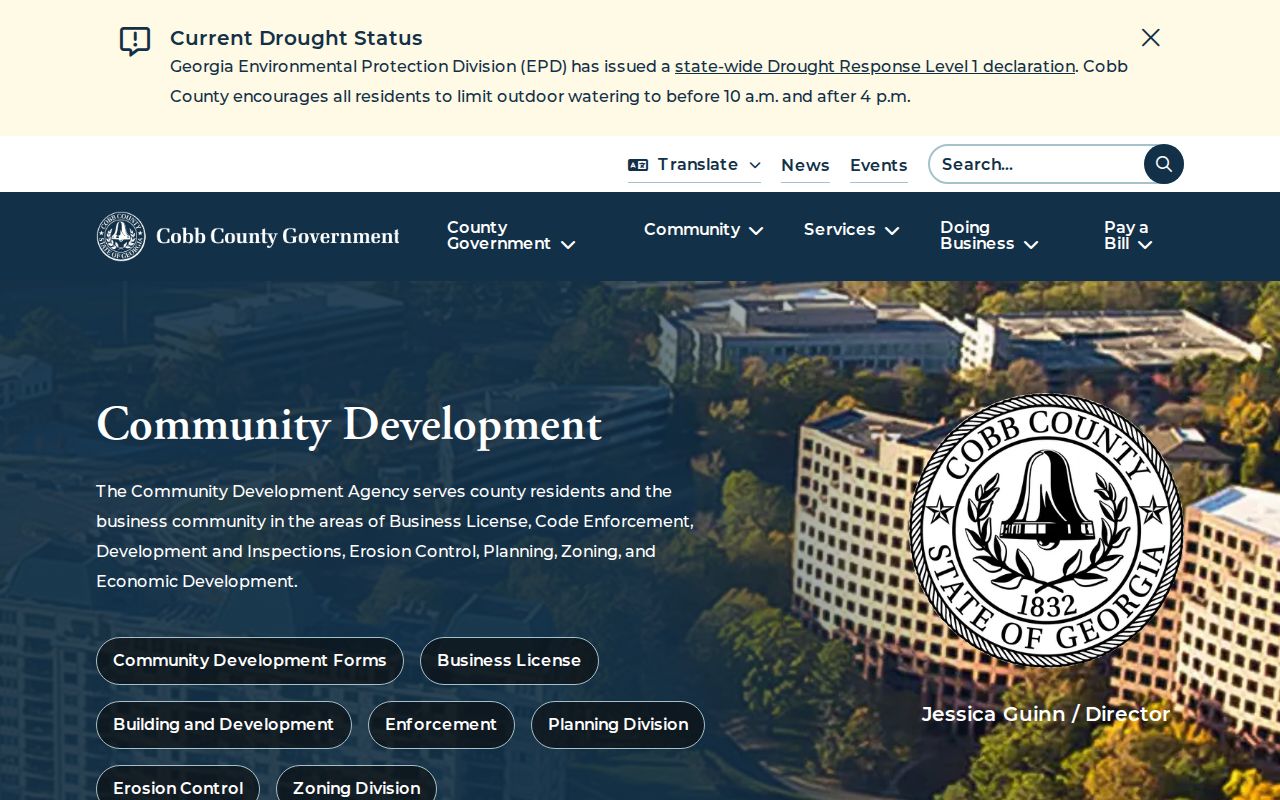
The page helps route an address question to the county unit that maintains its civic context instead of treating the USPS place name as the final jurisdiction answer.
Municipal boundaries still matter. Marietta, Smyrna, Kennesaw, Acworth, Austell, and Powder Springs may keep their own permits or local cases. A postal city on an envelope does not always settle whether an address is inside that city's legal limit. Use the parcel and municipal layer before choosing a custodian.
Check Deeds Around Cobb County Neighbors
The Clerk's Real Property Web Public Inquiry adds transactions to the block list. Its modes include person name, book and page, instrument, land description, cross-reference, street name, and CFN. A deed index can connect grantor and grantee names with recording dates and parcel descriptions. Grantor is the transferring party; grantee is the receiving party.
Street Name search is useful for activity along nearby lots, while Land Description search is stronger when several streets share a subdivision. Cobb's form exposes land district, land lot, subdivision, block, lot, and unit. At least subdivision or land district is required. Georgia's old land-lot survey terms still appear in current legal descriptions, so land district and lot can remain stable even after a road label changes.
A deed identifies title parties. It does not list everyone who lives on the parcel. Note the instrument type, recording date, book/page, and CFN, then open the image where available. Older or uncertain coverage belongs with the Clerk's Deed Room at 770-528-1328. The full named-street chain should remain separate from the short neighbor radius.
Note: Compare legal description and parcel ID before treating two similar street addresses as the same Cobb County lot.
Cobb County Neighbors and Voters
Georgia My Voter Page is designed for a person's own registration check. It asks for first initial, surname, county, and date of birth. It cannot list everyone on a block and should never be tested with guessed birth dates. The lawful street-level channel is the public voter file ordered from the Secretary of State.
Georgia law makes voter lists available for inspection and copies. Released fields can include voter name, residence and mailing address elements, registration status and date, last-vote date, precinct, and district codes. Date of birth, Social Security and driver's-license numbers, phone, and email are protected. VoteSafe also suppresses the residence addresses of qualified participants under protective orders or in family-violence shelters.
The official order route can select county, municipal, precinct, or district geography under the form's current choices and fees. A row marked inactive does not prove that the voter moved. Participation history means the person received turnout credit; it does not show a ballot choice. For corrections or an existing Cobb election record, contact Cobb Elections and Registration rather than inferring from a stale list.
Cobb Neighbor Associations and Contacts
Community groups add names of organizations and public contacts, not a complete list of neighbors. No authoritative Cobb-wide private HOA membership directory was found. The City of Marietta's Safe Neighborhoods page identifies 13 neighborhoods with an HOA contact on file. It does not disclose private rosters, and it only applies within the city's program.
Marietta Safe Neighborhoods
Official city list of participating neighborhood names and the HOA contact route. Use for a Marietta address, not all Cobb County.
Cobb Community Development
County planning, permits, addressing, and community resources for unincorporated areas. Use the official department source shown with the address-layer image above.
Georgia Room
Local-history collections can supply older neighborhood files, maps, newspapers, and organization records.
An association contact may know how to join, request governing papers, or receive public notices. It does not follow that the contact can release a member list. Churches, civic groups, and block-watch programs also set their own privacy rules. Ask for a public contact or published document, not a private household roster.
Cobb Neighbor Filing Alerts
The Georgia Clerks' Authority Filing Activity Notification System, or FANS, sends alerts when a registered name appears in newly indexed property filings. It can help an owner notice activity tied to a name, but it does not prevent a filing, insure title, or decide whether a deed is valid.
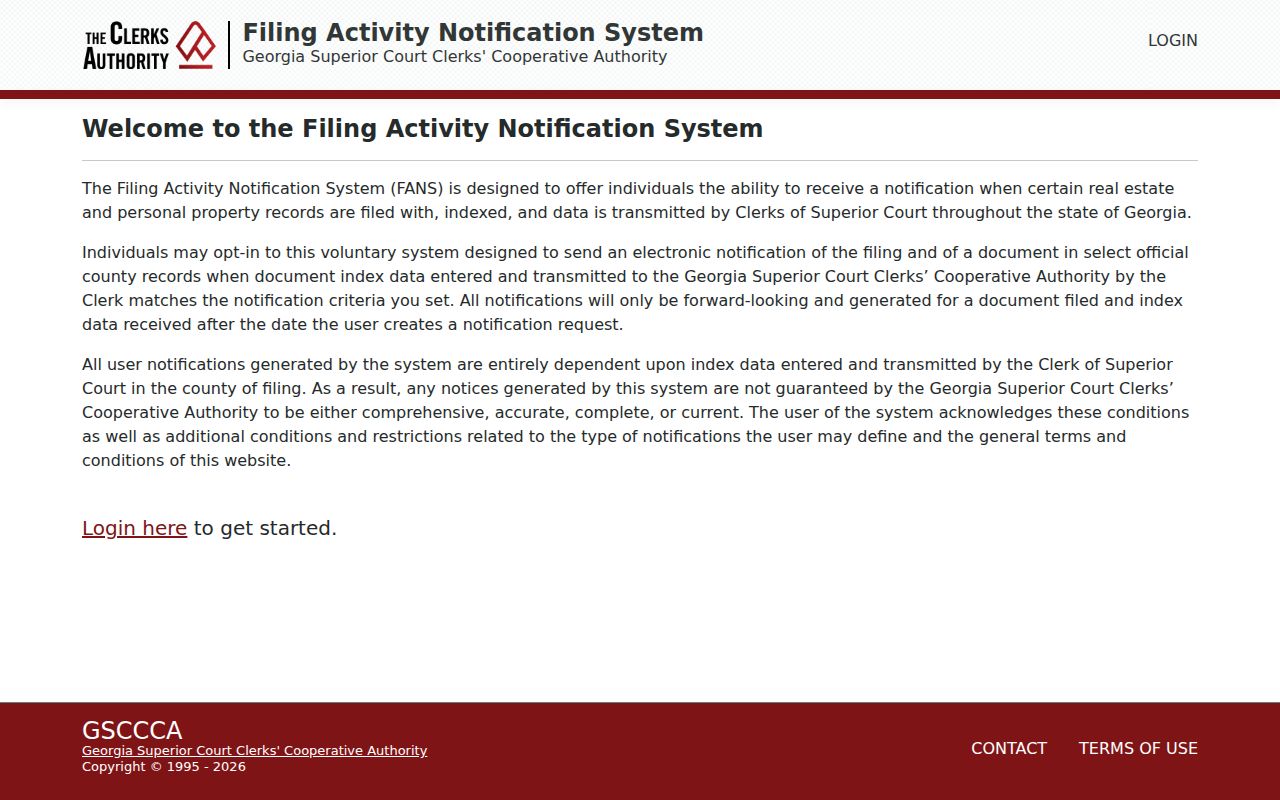
The captured signup source shows the statewide alert channel that Cobb owners can use after checking the clerk's official index.
Filing alerts are not a neighbor roster. They fit the block workflow when an owner wants to watch their own recorded-name activity or verify a suspicious deed notice. A solicitation may quote real parcel facts because tax rolls and deeds are public. Confirm it with the Cobb Clerk, not with contact details printed on the mailer.
Official Cobb Neighbor Records Compared
Official sources are narrower than commercial neighbor tools, yet they make their keeper and purpose clear. The assessor confirms an owner. GIS confirms parcel geography. The Clerk confirms recorded instruments. Elections supplies data under statute. A commercial directory may blend old addresses, phone data, and inferred relations without showing when or why each item changed.
| Source type | Best use | Main limit |
|---|---|---|
| County parcel and tax roll | Map lots and identify recorded owners | Does not list all occupants |
| Recorded deeds and plats | Confirm title parties and block geometry | Not a current household roll |
| Official voter file | Study lawfully released civic records | Protected fields and statutory use limits |
| Commercial neighbor category | Possible lead for further checking | Mixed sources, stale data, unclear inference |
Use a commercial lead, if encountered, only to return to the real custodian. Never treat a polished result card as proof that someone is a present Cobb County neighbor.
Privacy for Cobb County Neighbors
Public parcel and deed files do not erase privacy. Renters and unnamed household members may be absent. Utility, delivery, and school information is not a public neighbor directory. VoteSafe addresses are protected, and public voter files omit sensitive identifiers. Private associations may keep member rosters closed even when their organization name and officer contact are public.
Keep the search tied to a sound personal purpose, such as learning the lot pattern, reconnecting with a known person, checking a deed notice, researching neighborhood history, or finding a public association contact. Do not publish a protected or sensitive address. Do not watch, threaten, or pressure a person based on a record match.
Lawful use. Cobb County neighbor records must not be used to stalk, harass, threaten, or intimidate anyone.
When a map, roll, or list conflicts, ask the custodian which date and field controls. A careful block list marks unknown occupants as unknown. That is more accurate than filling gaps with assumptions.