
Cobb County Directory Years
The Georgia Room at Switzer Library holds the core Cobb County city directory collection. Its official inventory lists separate and changing runs, not a continuous set. Early books cover Marietta and Acworth. Mid-century titles focus on Marietta, then add Smyrna. Later titles add Acworth and Kennesaw, while Austell and Mableton have their own intermittent run. This changing footprint matters. A missing name may mean that the person's part of Cobb was outside that edition, not that the person had left the county.
| Directory collection | Years held | Repository | How to use it |
|---|---|---|---|
| Marietta and Acworth | 1883, 1884 | Georgia Room | Reference-only originals |
| Marietta City | 1936; 1938-39; 1941; 1944; 1947; 1950; 1952; 1956 | Georgia Room and selected DLG scans | In person or free online |
| Marietta and Smyrna | 1958-60; 1962; 1964-70 | Georgia Room and DLG | Reference copies and scans |
| Marietta, Smyrna, Acworth, Kennesaw | 1977; 1985-86; 1987 | Georgia Room | Reference-only; some scans |
| Austell and Mableton | 1967; 1969-74 | Georgia Room and DLG project | Reference copies; some scans |
The largest gap runs from the listed 1884 volume to 1936, and later gaps remain. The last year in the inventory is 1987, but that only proves the last volume held, not the last one printed. Verify each title page before naming a publisher. Baldwin Directory Co. is confirmed for 1938-39 and 1944, Mullin-Kille for 1975, and R. L. Polk for 1985-86 and 1987.
Cobb County Georgia Room Access
The Georgia Room is a noncirculating special collection inside Switzer Library at 266 Roswell Street in Marietta. It is open to everyone, needs no appointment, and offers staff research help. Call 770-528-2333 with a title and year request. The room began in 1970 through Virginia Van Stone Crosby's bequest, expanded in 2007, and moved to a purpose-built space during the 2021 Switzer renovation.
Because the books stay in the room, bring a camera or notebook and record the full title, year, page, and abbreviation key. The collection also includes maps, newspapers, church and cemetery material, manuscripts, family histories, and vertical files. Those sources can resolve a city directory entry that uses initials, an old rural route, or a shortened occupation.
The Georgia Room collection page shows where the Cobb County collection and staff help begin.
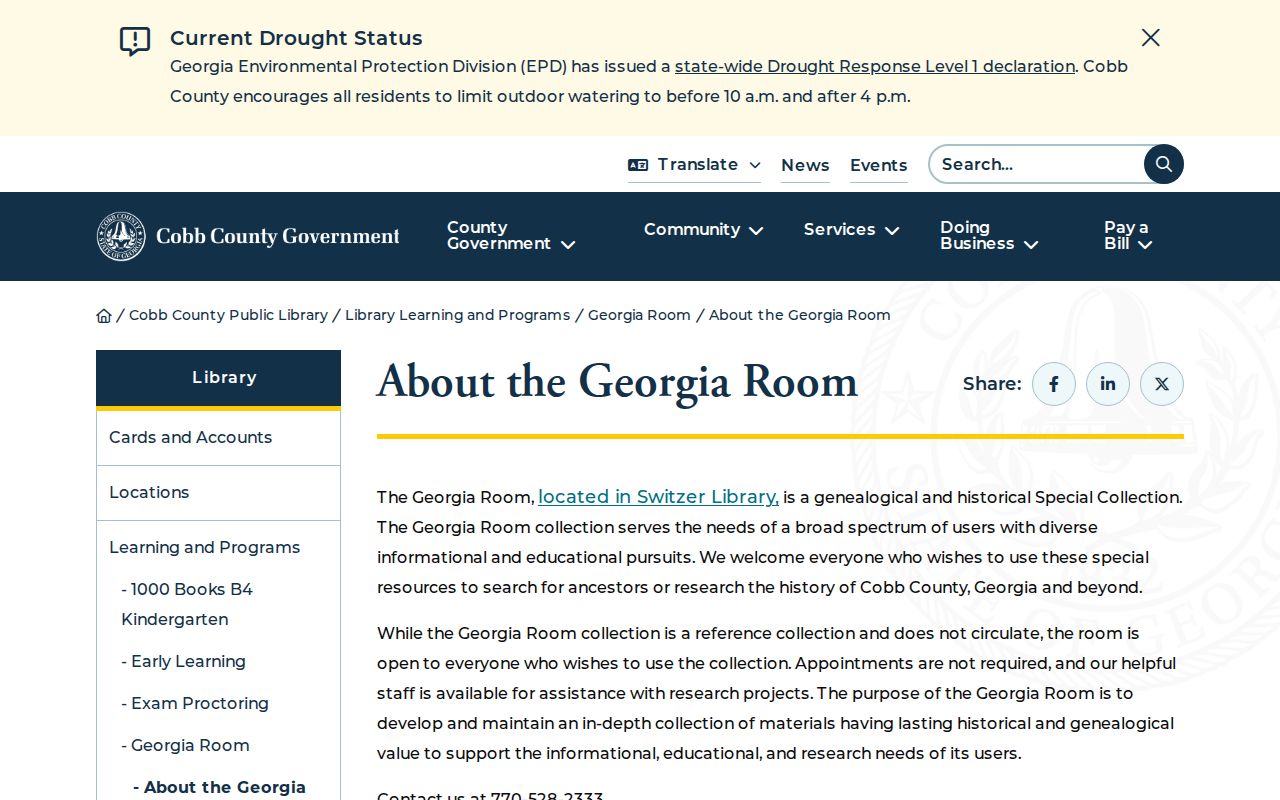
The captured Georgia Room page points researchers to the local desk that holds the original directory volumes and related Cobb history files.
Cobb County Directories Online
Georgia Public Library Service digitized 214 directories for 17 Georgia communities, including Marietta, Austell, Mableton, Acworth, and Smyrna. The Digital Library of Georgia hosts the Cobb scans for remote reading, page browsing, OCR text searching, and downloads. Useful examples include the 1938-39 Marietta directory, the 1944 wartime volume, the 1950 book, and the 1975 Marietta-Smyrna edition.
OCR is a starting point, not proof. Search a surname, initials, spouse, employer, and street spelling, then inspect the page image and nearby alphabetical entries. Narrow columns can merge. Faded letters may turn one surname into another. If no scan exists, use the Georgia Room shelf inventory and ask staff about the original.
Read Cobb County Directory Entries
The 1944 Marietta City Directory shows how much one compact line can hold. An actual entry names Jonah F. Hicks, places A. Maude in parentheses, identifies him as county sheriff, gives 722 Atlanta as the home, and lists telephone 763-J. A numeral also appears in the line, but its meaning should be checked against that volume's key instead of guessed. Nearby listings show widow forms, military status, employers, apartments, rural routes, and party-line phone suffixes.
| Name line | Adult name, initials, title, and sometimes a spouse in parentheses |
|---|---|
| Occupation line | Occupation, employer, public role, military status, or a short trade code |
| Home line | House number, street, apartment or rural route, often after h or r |
| Phone line | Period telephone number, sometimes with a party-line suffix |
| Family clue | Widow notation, spouse name, or another wage earner at the same address |
- Criss-cross directory
- A section arranged by street and house number instead of surname.
- Householder index
- A list keyed to the person responsible for a home, not every person inside it.
- Abbreviation key
- The volume's own guide to short forms. Save it before decoding any mark.
A city directory is not a census. It often emphasizes adults and wage earners, omits children, and can miss people who did not respond. Treat the line as a lead that needs support from another dated record.
Cobb Directory Records Wartime Growth
The 1944 city directory preserves Marietta's Bell Bomber surge at household scale. Its introduction estimates a population of 17,721, compared with 8,643 in the 1940 census. Many entries identify Bell Aircraft Corp. as the employer and add a specific trade. The directory therefore links a resident's name and home address to the plant expansion more closely than a broad county history can.
Use that occupation line as a matching aid, not as sole proof. Pair it with the scanned entry, the 1940 or 1950 census, newspaper material, and local manuscript collections. Bell closed after World War II, and Lockheed reopened the plant in 1951. That shift helps explain new names, moves, and changing occupations in the postwar volumes.
Cobb County Directory Timeline
The sequence of titles mirrors Cobb County's growth. It also tells the researcher which geographic label to search.
| 1883-84 | Marietta and Acworth titles appear in the Georgia Room inventory. |
|---|---|
| 1936-56 | Marietta-centered books resume after the long listed gap. |
| 1958-76 | Marietta and Smyrna share a title in selected years. |
| 1977 onward | The title expands to Marietta, Smyrna, Acworth, and Kennesaw. |
| 1987 | The final year held in the official Cobb inventory, not a proven end of publication. |
A separate Austell-Mableton run covers selected years from 1967 through 1987. Search the title that included the address during the year in question. An East Cobb or rural household may still be absent when the volume's city coverage did not reach it.
Trace Cobb County Family History
City directories bridge years between public federal census schedules. They can show when a surname first appears, when a household moves, and when a spouse or occupation changes. Since Cobb holdings skip years, move to the next available book in both directions. A disappearance may reflect a missing edition, move, death, military service, or nonresponse.
- Start with a full name and an approximate year. Repeat the search with initials, spouse names, and spelling variants.
- Copy the entry exactly, including street spelling, h or r marks, employer, phone, and rural-route text.
- Move to the next available book before and after it. Use a street section, when present, to check the same address.
- Pair 1883-84 with the 1880 census, 1936 or 1938-39 with 1940, and 1947-52 with the 1950 census.
- Close gaps with newspaper, cemetery, probate, deed, tax, or church records held by the Georgia Room and Georgia Archives.
Federal population schedules become public after 72 years, so 1950 is the newest released census as of 2026. A census can add ages, birthplaces, and relationships that the directory lacks. A directory can then narrow a move to the years between census counts. Neither source alone proves kinship.
Cobb County Records Beyond Directories
The Georgia Archives is the next stop when the local shelf has a gap. Its Reference Room offers city directories, census indexes, land-lottery material, county histories, tax-digest tools, maps, newspaper microfilm, and marriage, divorce, and death index microfiche. The Virtual Vault County Records Microfilm Index identifies older Cobb books by series and reel. Select Cobb and inspect the catalog card rather than assuming the 1864 courthouse destruction erased every early record.
The Georgia Archives research page introduces those onsite and catalog routes.
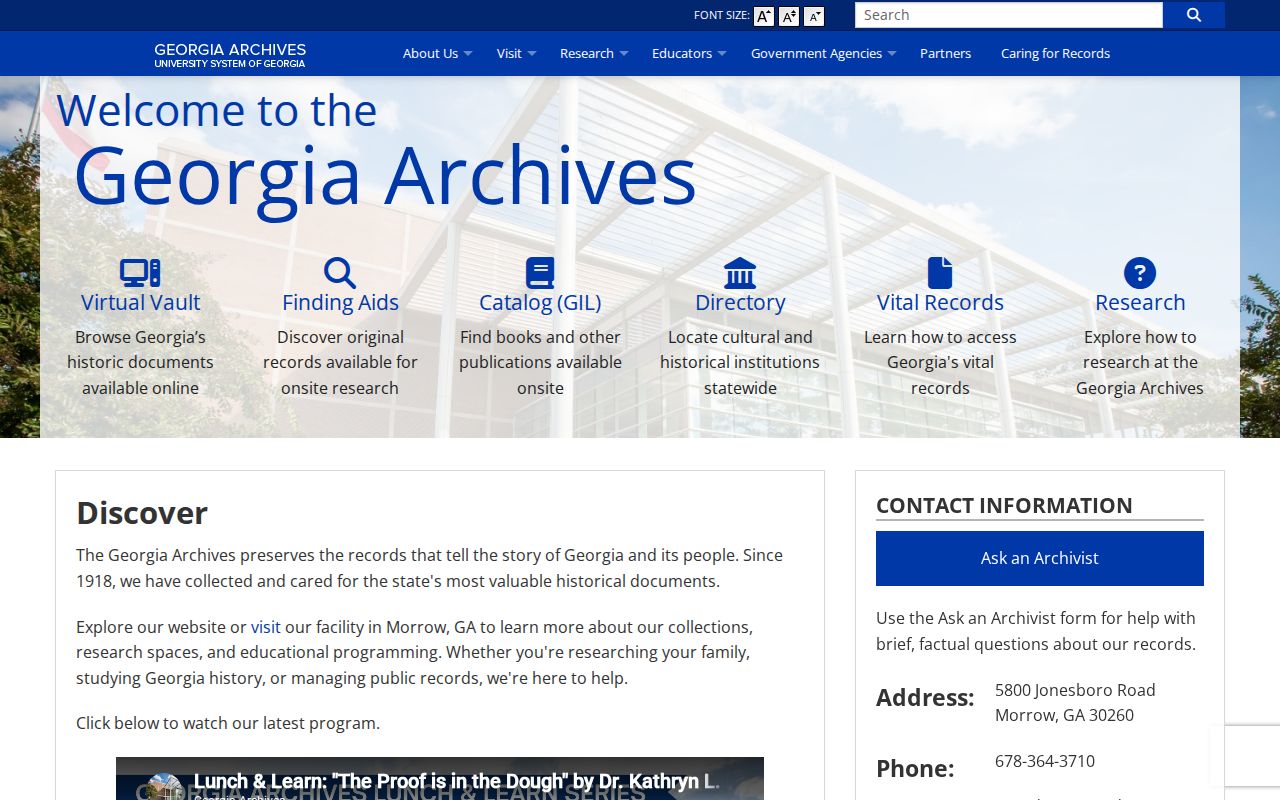
The Georgia Archives capture marks the statewide fallback for directory gaps, county microfilm, and records created before Cobb County existed in 1832.