
Finding Cobb County Residents
Cobb County keeps no master list of everyone who lives here. Each public record answers a smaller question. The tax roll links a parcel to an owner. Recorded deeds identify buyers, sellers, and legal descriptions. Court dockets connect named parties to filed cases. Historical directories may name occupants who never held title. That split is why a reliable Cobb County residents directory search begins by defining the claim: current owner, registered voter, party to a case, former occupant, heir, or business contact.
Use dates as well as names. A portal result may be current, updated nightly, or tied to the date an instrument was recorded. Common names also need a second match, such as a middle initial, parcel number, spouse, case number, or known street. Owners are not always occupants, and an owner mailing address can differ from the property's situs address, the physical location of the parcel.
- Enter a street address in the county property gateway to identify the parcel and owner.
- Keep the parcel ID, legal description, and deed book and page as stable reference points.
- For a named person, check the separate State, Superior, and Probate Court searches when relevant.
- Use the Georgia Room's directories and microform when the question concerns a past household.
- Ask the correct custodian for an existing record that is not available online.
Cobb County Directory Custodians
Three offices form the core of the Cobb County residents directory trail. The Superior Court Clerk records deeds and other real-estate instruments. The Board of Tax Assessors maintains parcel ownership and valuation data. Cobb Elections manages local registration while Georgia's My Voter Page gives an individual a secure way to confirm personal registration and district details. These offices document different facts, so their records should be compared rather than treated as interchangeable. The Cobb County street directory explains the address-to-parcel path in full.
Superior Court Real Estate Division
10 East Park Square, Building C
Marietta, GA 30090
770-528-1328
Cobb Board of Tax Assessors
736 Whitlock Avenue, Suite 200
Marietta, GA 30064
770-528-3100
The assessor page is the official entry to the property roll. Its screen is shown in the Cobb Tax Assessor source below.
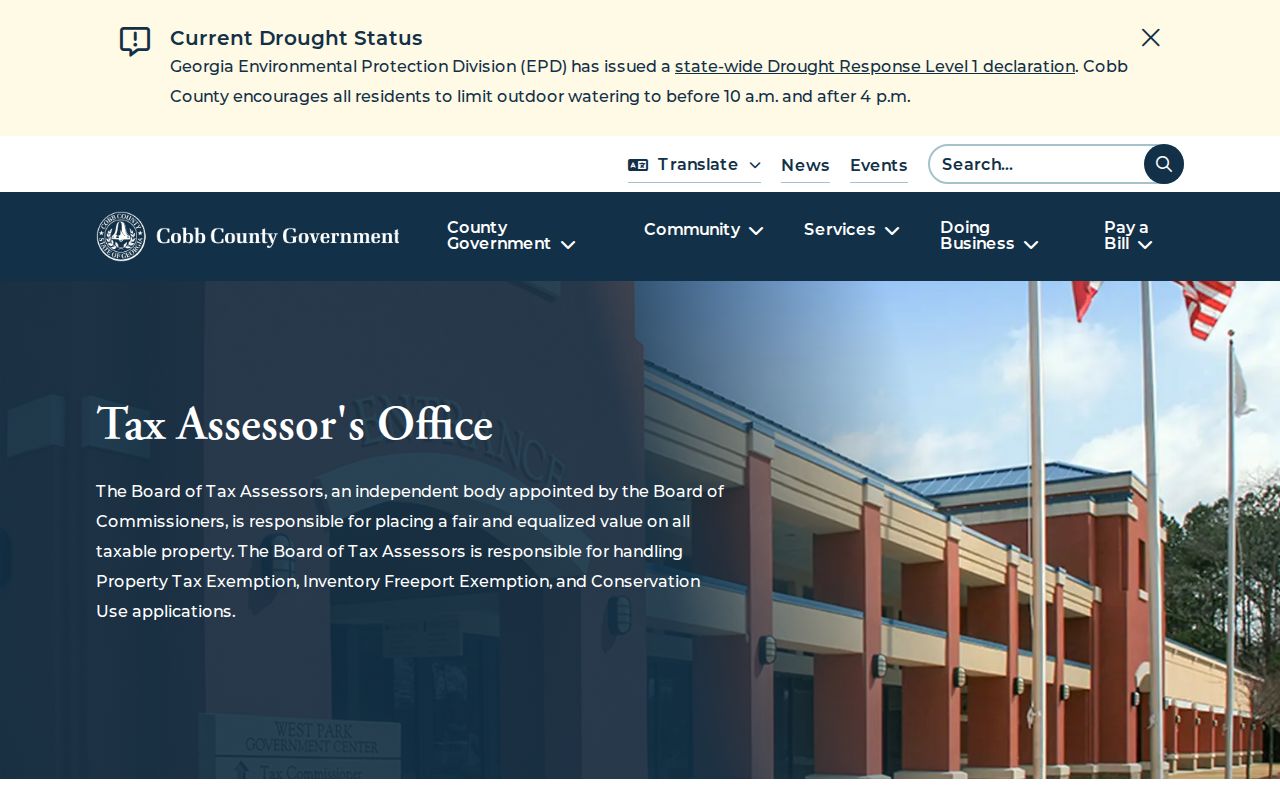
The county page leads to searchable owner, address, parcel, and assessment tools, while the assessor's office remains the place to question or correct its data.
Cobb County Address Record Clues
The county's narrow address gateway asks for only a house number and street. It specifically excludes apartment or unit, city, state, and ZIP. That small detail prevents many false no-result searches. Once the record opens, save the parcel ID, property address, owner, tax district, property class, and deed reference. A parcel is a mapped unit of land with its own identifier. It remains more reliable than a person's name when a property changes hands.
- Situs address
- The physical address assigned to the parcel.
- Mailing address
- The destination where the assessor sends owner correspondence.
- Parcel ID
- The county's stable identifier for a mapped tax parcel.
- Legal description
- The land district, land lot, subdivision, block, or lot language identifying the land.
An owner mailing address that matches the situs can support, but does not prove, occupancy. A homestead exemption is a stronger owner-occupancy clue, yet it still does not name every person in a household. Trusts, estates, business entities, redactions for protected people, and delayed updates can all change what appears online.
Note: Keep the parcel ID before leaving the assessor record because it can reconnect an address to maps, taxes, and recorded deeds.
Cobb County Deed Directory Modes
The Clerk's real-property inquiry offers more than a basic name box. Search modes include name, book and page, instrument type, land description, cross-reference, street name, and CFN. CFN means Clerk's File Number. Cobb defines it as a four-digit year plus a seven-digit sequence, and leading zeroes in the sequence may be omitted. The current Landmark interface also exposes parcel ID, record-date range, instrument number, and legal-description searches.
| Index route | Best use | Key caution |
|---|---|---|
| Name | Find grantors or grantees | Try spelling variants |
| Book and page | Open a cited instrument | The official office record controls |
| Street name | Review filings tied to a road | Street text can change |
| Land description | Hold to a land lot or subdivision | Subdivision or land district is required |
| CFN | Retrieve a known filing | Retain the full year and sequence |
A deed image may add recording time, transfer information, return-to details, party names, land lot and district, subdivision lot, and a referenced plat. Use those details with care. The index is a finding aid; a certified copy comes from the Clerk. The Deed Room also handles uncertain coverage and copy needs at the courthouse counter or by mail.
Current Cobb County Resident Records
Modern sources resemble a directory only within their own limits. The assessor lists owners, not whole households. The deed index lists parties to recorded instruments. Court indexes list case parties. Voter access is split between a personal lookup and public lists obtained under Georgia law. Official business and license systems can verify a named role or credential, but a registered-agent or office address should never be relabeled as a home.
| Official source | Fact it can support | Custodian | Access route |
|---|---|---|---|
| Property roll | Owner, parcel, situs, mailing address | Tax Assessors | Free web tools and office |
| Real-estate index | Parties, filing, land description | Superior Court Clerk | Web index, Deed Room, mail |
| Court dockets | Named party, role, case events | Separate court clerks | Portal and official file |
| Voter records | Registration and district information | Elections and Secretary of State | Personal lookup or list request |
| Georgia Room | Past named occupants and family clues | Cobb County Public Library | In-person shelf, databases, staff help |
For one name, write down variants, suffixes, an approximate age, and a known Cobb place before searching. Then record the source URL and access date. The Cobb County resident lookup uses that verification sequence without turning a loose name match into a claim.
Separate Cobb County Court Directories
Cobb's courts do not share one complete public search. State Court publishes civil and traffic or misdemeanor records in its own system. Superior Court offers separate civil and criminal tabs. Probate Court searches selected documents by document type, case number or application name, with an optional event-date range. Magistrate Court has another index, and a citation from Marietta or another incorporated city may remain with that municipal court.
The Cobb State Court search provides a useful example of a party search, shown below. It allows civil or criminal mode, first and last name, phonetic matching, a birth year in criminal search, case number, and filing-date ranges.
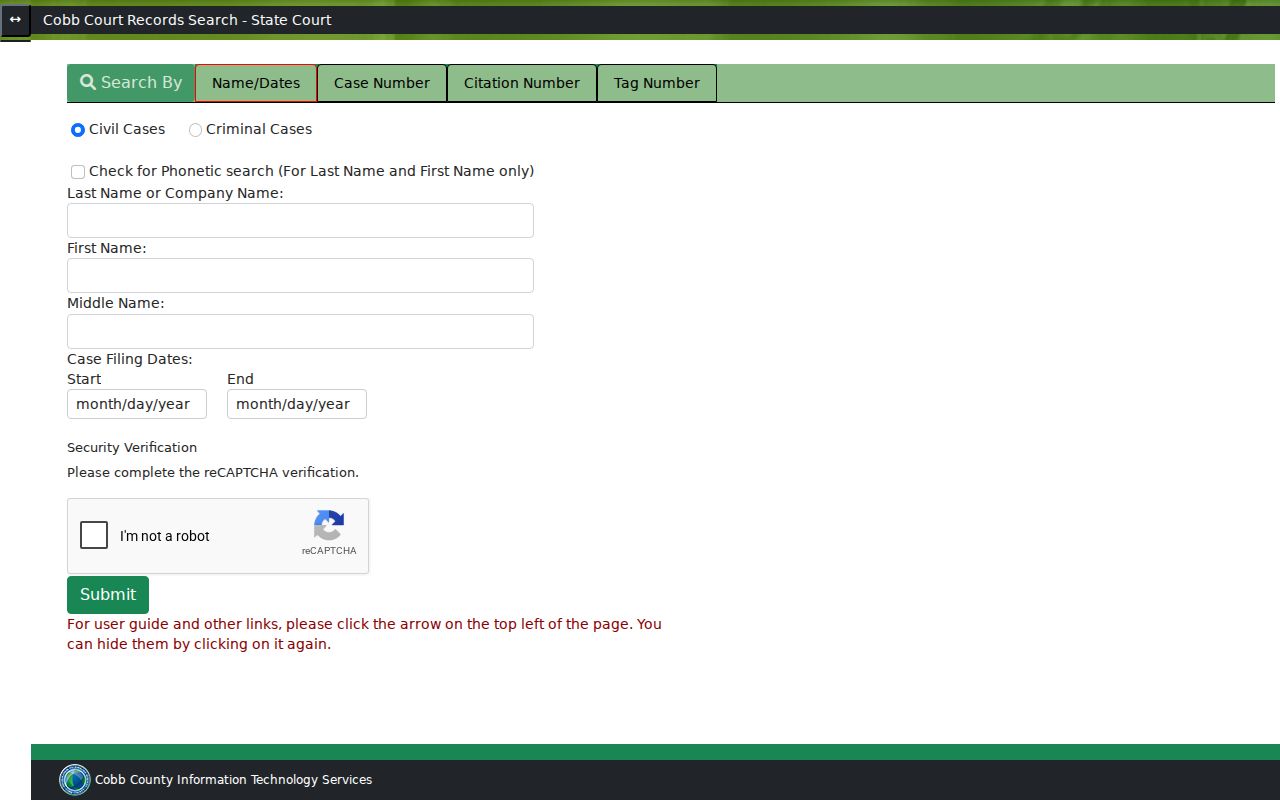
State Court says its web data refreshes nightly. Published civil coverage begins March 17, 1997, while traffic and misdemeanor coverage begins April 26, 1999. The official file at 12 East Park Square controls if a screen and clerk record differ.
Cobb County Probate Family Records
Marriage, death, divorce, and estate records have different keepers. Cobb Probate Court provides marriage-license copies and estate records. Cobb and Douglas Public Health serves Georgia birth and death certificates from 1919 forward. Divorce files belong to the Superior Court Clerk. Birth certificates remain restricted to eligible applicants, while Georgia law keeps county death, marriage, and divorce records publicly accessible with protected identifiers redacted.
The Cobb Probate Document Inquiry lets a researcher select a document type and search by a case number or application name. Its form is captured below.
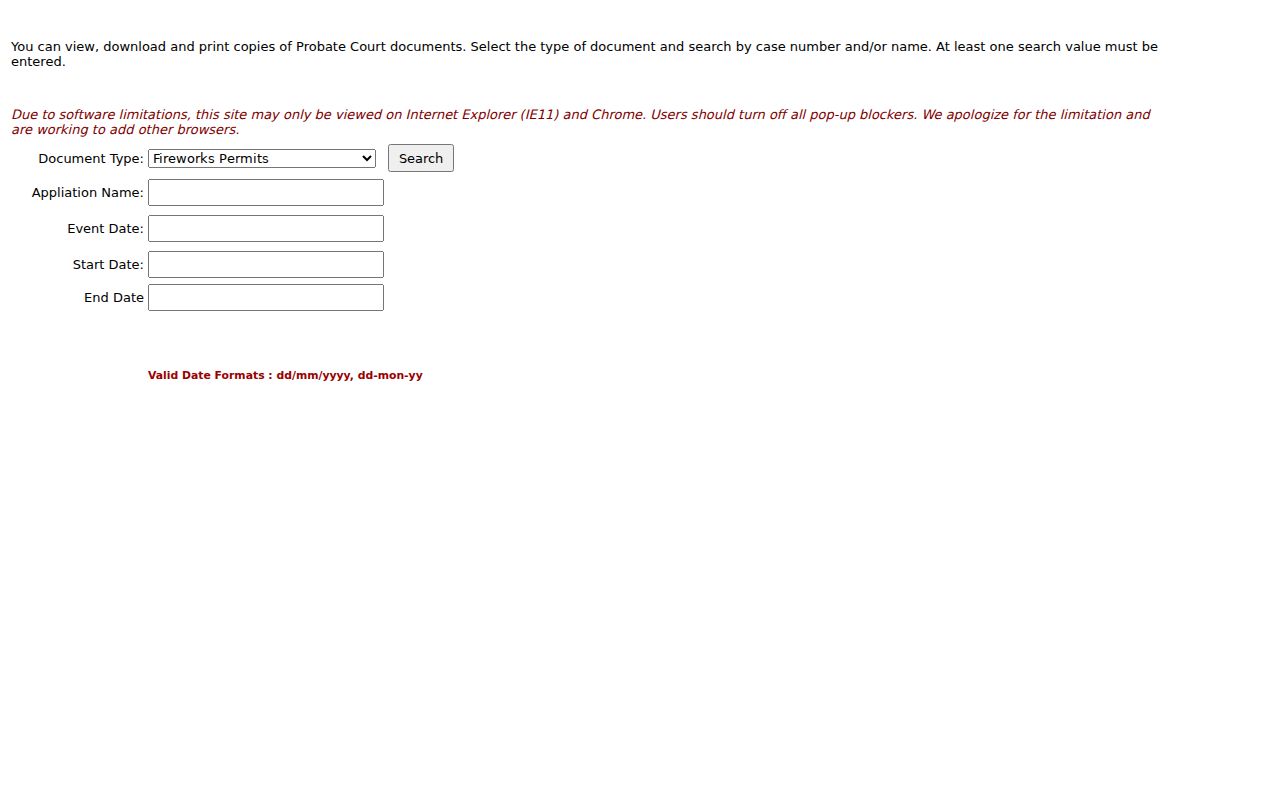
Probate petitions, orders, wills, executors, and heirs can join a deceased resident to relatives and real property. Some guardianship and sensitive files may be limited. A portal image is useful for research, while a certified copy is the formal record.
Georgia Voter Directory Boundaries
Georgia's My Voter Page is an individualized service. A person enters identifying data to see personal registration status, polling place, districts, sample ballots, and absentee information. It is not a free-form search for any neighbor. Public voter lists are instead governed by O.C.G.A. §§ 21-2-225 and 21-2-226 and can include names and addresses, but month and day of birth, identification numbers, and protected VoteSafe residence addresses are withheld.
The Georgia My Voter Page is the official personal access point shown here.
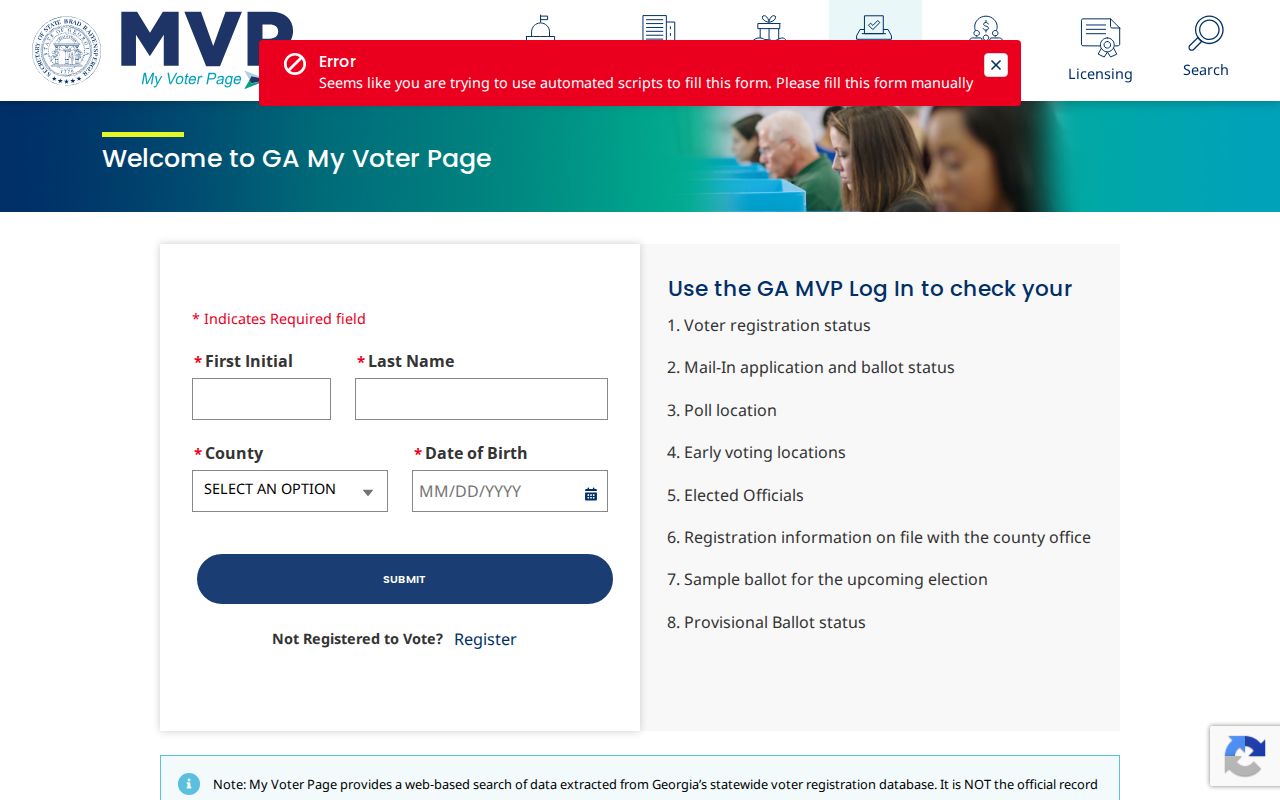
VoteSafe protects the residence address of qualified registered voters under protective or restraining orders or living in a family-violence shelter. That protection is a firm boundary, not a gap to work around. Voter participation never reveals how anyone voted.
Cobb County Records Beyond Portals
Online indexes are only one access channel. The Real Estate Division has a Deed Room and accepts mailed copy requests. Court clerks supply ordinary or certified copies, and the official case file controls over the online docket. Public Health accepts vital-record requests in person and by mail, with state methods also available. The Georgia Room provides noncirculating volumes, microform, databases, and one-hour genealogy help appointments. The Georgia Archives holds county microfilm and older government records.
When an existing, nonexempt county record is not published, a focused Georgia Open Records Act request can identify the custodian, record series, date range, and preferred electronic format. Under O.C.G.A. § 50-18-71, the agency must produce available records within three business days or give the expected timing, cost, and legal basis for withholding. An agency need not create a new list that does not already exist.
The state's open-records request form demonstrates the kind of description and delivery fields a clear request uses.
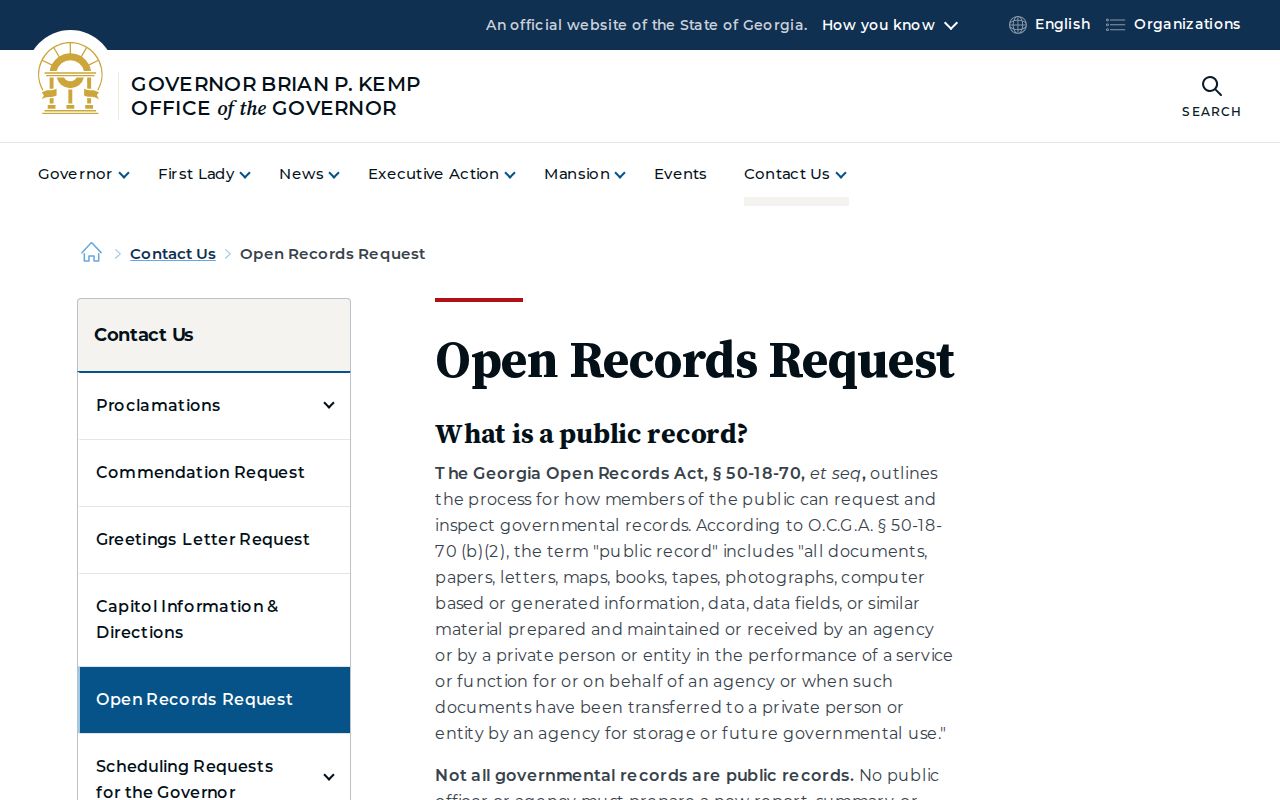
The form reinforces that requests work best when they ask for known records, not research or a newly compiled directory. County-specific requests should still go to the Cobb office that holds the material.
Cobb County Record Indexes Versus Proof
A result screen is a lead, not automatic proof of current residence. Cobb's State Court warns that online data is unofficial. The deed search points to a recorded instrument but does not name all occupants. The assessor reflects an annual tax process and distinguishes the owner address from the property address. Printed directories capture what a publisher recorded in one edition. Each source becomes stronger when another independent record agrees.
| Finding aid | What to verify | Best follow-up |
|---|---|---|
| Portal name hit | Identity, role, date | Official file or certified copy |
| Owner record | Whether owner also occupied | Homestead clue, directory, dated record |
| Directory entry | Spelling and edition year | Adjacent editions, census, deed, probate |
| Commercial compilation | Source date and errors | Return to the named official custodian |
Commercial people-finding compilations can merge people with similar names, retain old addresses, and hide source dates. Describe any match as unconfirmed until a public custodian's record supports it. Do not republish sensitive detail merely because a document is open.
Cobb County Filing Alerts
The Georgia Clerks' Authority operates the free Filing Activity Notification System, or FANS. A user registers names and receives notice when a real-estate, lien, or plat filing is indexed under one of them. The service can help an owner notice activity sooner, but it does not prevent a filing, decide whether a deed is valid, or replace review by the Cobb Clerk's Real Estate Division.
Georgia also changed real-estate electronic filing rules in January 2025. Electronic filers now face identity-verification requirements. For a Cobb County residents directory researcher, the practical point is still simple: preserve the index identifiers, inspect the recorded image, and ask the Clerk when authenticity or status matters.
Historical Cobb County Directories
Switzer Library's Georgia Room is the local shelf for past Cobb residents. It holds Marietta and Acworth directories from 1883 and 1884; Marietta volumes for 1936, 1938-39, 1941, 1944, 1947, 1950, 1952, and 1956; combined Marietta and Smyrna volumes for 1958-60, 1962, and 1964-70; broader Marietta, Smyrna, Acworth, and Kennesaw editions for 1977, 1985-86, and 1987; and Austell and Mableton volumes for 1967 and 1969-74.
A city directory may list a resident's name, spouse, occupation, employer, or street address. Some editions include an address-arranged section that works in reverse, turning a street into names. Read the exact entry and its abbreviations, then compare the editions before and after it. Census schedules, deeds, newspapers, probate files, and vital records can bridge missing years and distinguish an owner from an occupant.
The Georgia Room overview shows the collection's local-history setting.
Materials do not circulate, but no appointment is required. Staff at 266 Roswell Street in Marietta can also help with microform, obituary-oriented vertical files, and genealogy databases. Full collection details belong in the Cobb County city directory.
Note: Cobb County was created in 1832, and its early land-district and land-lot terms still anchor many modern legal descriptions.